| MOQ: | 1 Tons |
| Price: | 800-1000 USD/Tons |
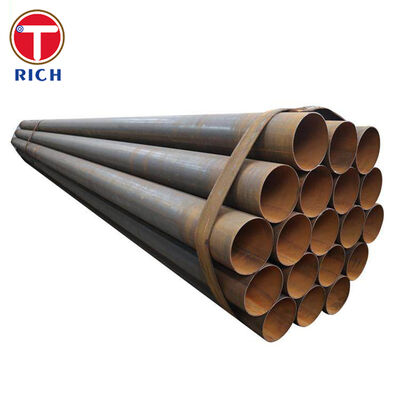
| Standard Packaging: | In bundles or in wooden boxes. |
| Delivery Period: | 20-30days upon products |
| Payment Method: | L/C, D/A, D/P, T/T, Western Union, MoneyGram |
| Supply Capacity: | 60000 Ton/Tons per Year |
![]()
JIS G3472 specifies electric resistance welded (ERW) carbon steel tubes used as structural members in automotive applications. The tubes are made from low- to medium-carbon steels (STAM grades) optimized for a combination of strength, formability, and weldability, and are intended for components such as prop shafts, steering columns, seat structures, and safety-related reinforcements.
Manufacturing process
Electric resistance welded (ERW) from strip or coil, with controlled weld seam quality and optional after-weld heat treatment.
Supply conditions: as-welded, normalized, or stress-relieved depending on grade and customer requirement (typical for automotive mechanical tubing).
Dimensional range
Based on JIS G3472 and common supplier practice:
Outside diameter (OD): approx. 15.9–101.6 mm (standard allows up to about 127 mm)
Wall thickness (WT): approx. 1.0–6.0 mm (standard range up to about 7.0 mm)
Standard commercial lengths: 3–9 m (e.g., 3000–9000 mm) with custom cut lengths on request.
Delivery & finish
Ends: normally plain or deburred; bevelled ends or machined ends on request.
Surface: black (mill finish), light oiled; phosphated or other coatings available for corrosion protection depending on supplier.
Available strength grades (JIS G3472)
Typical grades for structural use include: STAM 290GA/GB, 340G, 390G, 440G/H, 470G/H, 500G/H, 540H.
Automotive-oriented strength ladder
STAM grades cover yield strengths roughly from 175 to 480 MPa and tensile strengths from about 290 to 540 MPa, allowing precise matching of tube strength to each automotive component’s crash and fatigue requirements.
Good formability and weldability
Low- to medium-carbon composition with controlled sulfur and phosphorous (typically ≤0.035%) gives good cold-bending, flaring and hydroforming performance while maintaining weldability and toughness.
Tight dimensional tolerance for structural fit-up
ERW tubes are supplied with controlled OD, wall thickness and straightness according to JIS G3472 and general ERW tolerance practice, which directly supports accurate assembly and consistent structural behaviour in automotive frames and modules.
Validated forming performance (flaring test)
JIS G3472 includes mandatory flaring tests (e.g. 1.20D–1.25D bell size depending on grade), proving the tube’s capacity to withstand end-forming, expansion and local deformation used in automotive joints and bushings.
Consistent quality for safety-critical parts
Tubes are produced under automotive-grade quality systems and subjected to mechanical tests, flattening, flaring and non-destructive testing, making them suitable for safety components like seat-belt tensioner housings and airbag sleeves.
1. “Will the tubes match my design strength and crash targets?”
We offer a full STAM grade spectrum (290–540 level) and can recommend suitable grades based on required yield/tensile strength and elongation. For example, STAM 290GB is ideal for highly formable brackets, while STAM 440G or 470G are suited to safety-critical structural reinforcements demanding higher energy absorption.
2. “Can the tubes be bent, flared and hydroformed without cracking?”
The JIS G3472 design itself requires flaring performance up to 1.25D depending on grade, and the relatively low carbon levels (≤0.30%) plus controlled Mn and Si content ensure robust cold-forming behaviour. We can supply forming data and trial samples to validate your bending, swaging, or hydroforming processes.
3. “How stable are weld seams and dimensional tolerances?”
Our tubes are produced on ERW lines designed for automotive use, with continuous monitoring of weld power, seam geometry, OD, WT and straightness. This keeps dimensional variation within the JIS G3472 tolerance bands and reduces downstream problems in robotic welding and jig assembly commonly reported with non-automotive ERW pipe.
4. “Can you customize lengths and cut/processed parts?”
In addition to standard 3–9 m stock lengths, we can supply cut-to-length tubes and pre-processed pieces (saw-cut, deburred, drilled or end-formed) against your drawings, which reduces waste and in-house processing time for OEMs and Tier-1 suppliers.
5. “Is logistics support available for first-time import or multi-plant delivery?”
We align with the typical model of leading JIS G3472 mills: multi-length packing, export-ready bundles and cooperation with freight forwarders so tubes arrive line-ready.
6. “How does this product align with global standards?”
While JIS G3472 is a dedicated Japanese automotive standard, the tubes are broadly comparable to ASTM A513 automotive mechanical tubing, BS/EN precision/ERW automotive tubes (e.g. EN 10305-3 welded cold-sized tubes, BS 6323 ERW grades), and GB/T 13793 or GB/T 3091 structural/low-pressure ERW tubes in terms of manufacturing route and property levels. This makes material substitution studies and cross-plant sourcing easier.
| Grade | C (max, %) | Si (max, %) | Mn (%)* | P (max, %) | S (max, %) | Notes |
|---|---|---|---|---|---|---|
| STAM 290GB | 0.12 | 0.35 | 0.60 max | 0.035 | 0.035 | Low-strength, high-ductility |
| STAM 340G | 0.20 | 0.35 | 0.60 max | 0.035 | 0.035 | Higher C for increased strength |
| STAM 390G | 0.25 | 0.35 | 0.30–0.90 | 0.035 | 0.035 | Mn-strengthened grade |
| STAM 440G | 0.25 | 0.35 | 0.30–0.90 | 0.035 | 0.035 | Higher-strength structural grade |
| STAM 470G | 0.25 | 0.35 | 0.30–0.90 | 0.035 | 0.035 | High strength with good formability |
| Grade | Tensile strength Rm min (MPa) | Yield strength ReL min (MPa) | Elongation A min (%) | Flaring test – size of flared bell (D = OD) |
|---|---|---|---|---|
| STAM 290GB | 290 | 175 | 35 | 1.20 D |
| STAM 340G | 340 | 195 | 35 | 1.20 D |
| STAM 390G | 390 | 235 | 30 | 1.20 D |
| STAM 440G | 440 | 305 | 25 | 1.15 D |
| STAM 470G | 470 | 325 | 22 | 1.15 D |
Primary standard (Japan, JIS)
JIS G3472 – Electric resistance welded carbon steel tubes for automobile; covers ERW round tubes for automotive structural purposes.
Related / comparable standards in other systems
(These are functionally similar ERW structural/mechanical tube standards often used in comparable applications, not strict one-to-one equivalents.)
ASTM / ASME (USA)
ASTM A513 – Electric-Resistance-Welded Carbon and Alloy Steel Mechanical Tubing, widely used for automotive seat frames, suspension components and other mechanical parts.
ASTM A53 Type E – ERW carbon steel pipe for structural and pressure service (more general pipe vs. dedicated automotive tube).
EN / BS (Europe/UK)
EN 10305-3 / BS EN 10305-3 – Welded cold-sized tubes for precision applications (including automotive structures, frames, and mechanical uses).
BS 6323 (Part 5) – ERW steel tubes for automotive and mechanical applications, with graded strength levels similar in concept to STAM grades.
GB (China)
GB/T 13793 – Steel pipes with a longitudinal electric (resistance) weld, for structural and general purposes (OD ≤ 711 mm).
GB/T 3091 – Welded steel pipes for low-pressure fluid delivery (HFW/SAW pipes), sometimes used where structural and fluid service are combined.
Other national standards
IS 3074 (India) – Steel tubes for automotive purposes.
Various producers also reference EN 10219 (cold-formed welded structural hollow sections) and corresponding GOST precision/automotive tube standards in Russian-speaking markets.
When cross-referencing, mechanical properties, chemistry, and dimensional tolerances should be compared directly; design engineers should not assume direct interchangeability without verification.
JIS G3472 ERW carbon structural tubes are intended primarily for automotive structural components, but the same property set makes them suitable for:
Passenger car and light truck body-in-white reinforcements
Chassis and suspension modules
Powertrain and driveline structures
Automotive safety systems housings
General mechanical structures where controlled strength and formability are critical
Based on common supplier data and industry practice:
Chassis & frame
Side members, cross-members, sub-frames
Front and rear bumper reinforcements
Suspension control arms and links (for suitable grades)
Driveline components
Propeller shafts and intermediate shafts
Axle solutions made from tubes and axle housings
Stub-shaft sleeves and torque-tube elements
Steering & control systems
Steering columns and intermediate shafts
Steering gear housings and brackets
Safety restraint systems
Seat belt tensioner tubes and anchor sleeves
Airbag inflator housings and generator sleeves
Seat frame side members and head-rest supports
Body & interior structures
Seat frames and rails
Roof bows, door impact beams and pillar reinforcements
Brackets for exhaust, fuel tank, and under-body systems
Other mechanical uses
Structural members in machinery, furniture frames, and warehouse racking where automotive-grade tolerances and strength are advantageous.
![]()
![]()
![]()
![]()
A: manufacturer,also can do trading.
A: Generally speaking,it is 10-15 days if the goods are in stock,or it is 30-40 days if the goods are not in stock, it is according to quantity.
A: Yes, we could offer the sample for free charge but need pay the cost of freight.
A: Payment<=2000USD, 100% in advance. Payment>=2000USD, 30% T/T in advance ,balance before shippment.
If you have another question, pls feel free to contact with me.
| MOQ: | 1 Tons |
| Price: | 800-1000 USD/Tons |
| Standard Packaging: | In bundles or in wooden boxes. |
| Delivery Period: | 20-30days upon products |
| Payment Method: | L/C, D/A, D/P, T/T, Western Union, MoneyGram |
| Supply Capacity: | 60000 Ton/Tons per Year |
![]()
JIS G3472 specifies electric resistance welded (ERW) carbon steel tubes used as structural members in automotive applications. The tubes are made from low- to medium-carbon steels (STAM grades) optimized for a combination of strength, formability, and weldability, and are intended for components such as prop shafts, steering columns, seat structures, and safety-related reinforcements.
Manufacturing process
Electric resistance welded (ERW) from strip or coil, with controlled weld seam quality and optional after-weld heat treatment.
Supply conditions: as-welded, normalized, or stress-relieved depending on grade and customer requirement (typical for automotive mechanical tubing).
Dimensional range
Based on JIS G3472 and common supplier practice:
Outside diameter (OD): approx. 15.9–101.6 mm (standard allows up to about 127 mm)
Wall thickness (WT): approx. 1.0–6.0 mm (standard range up to about 7.0 mm)
Standard commercial lengths: 3–9 m (e.g., 3000–9000 mm) with custom cut lengths on request.
Delivery & finish
Ends: normally plain or deburred; bevelled ends or machined ends on request.
Surface: black (mill finish), light oiled; phosphated or other coatings available for corrosion protection depending on supplier.
Available strength grades (JIS G3472)
Typical grades for structural use include: STAM 290GA/GB, 340G, 390G, 440G/H, 470G/H, 500G/H, 540H.
Automotive-oriented strength ladder
STAM grades cover yield strengths roughly from 175 to 480 MPa and tensile strengths from about 290 to 540 MPa, allowing precise matching of tube strength to each automotive component’s crash and fatigue requirements.
Good formability and weldability
Low- to medium-carbon composition with controlled sulfur and phosphorous (typically ≤0.035%) gives good cold-bending, flaring and hydroforming performance while maintaining weldability and toughness.
Tight dimensional tolerance for structural fit-up
ERW tubes are supplied with controlled OD, wall thickness and straightness according to JIS G3472 and general ERW tolerance practice, which directly supports accurate assembly and consistent structural behaviour in automotive frames and modules.
Validated forming performance (flaring test)
JIS G3472 includes mandatory flaring tests (e.g. 1.20D–1.25D bell size depending on grade), proving the tube’s capacity to withstand end-forming, expansion and local deformation used in automotive joints and bushings.
Consistent quality for safety-critical parts
Tubes are produced under automotive-grade quality systems and subjected to mechanical tests, flattening, flaring and non-destructive testing, making them suitable for safety components like seat-belt tensioner housings and airbag sleeves.
1. “Will the tubes match my design strength and crash targets?”
We offer a full STAM grade spectrum (290–540 level) and can recommend suitable grades based on required yield/tensile strength and elongation. For example, STAM 290GB is ideal for highly formable brackets, while STAM 440G or 470G are suited to safety-critical structural reinforcements demanding higher energy absorption.
2. “Can the tubes be bent, flared and hydroformed without cracking?”
The JIS G3472 design itself requires flaring performance up to 1.25D depending on grade, and the relatively low carbon levels (≤0.30%) plus controlled Mn and Si content ensure robust cold-forming behaviour. We can supply forming data and trial samples to validate your bending, swaging, or hydroforming processes.
3. “How stable are weld seams and dimensional tolerances?”
Our tubes are produced on ERW lines designed for automotive use, with continuous monitoring of weld power, seam geometry, OD, WT and straightness. This keeps dimensional variation within the JIS G3472 tolerance bands and reduces downstream problems in robotic welding and jig assembly commonly reported with non-automotive ERW pipe.
4. “Can you customize lengths and cut/processed parts?”
In addition to standard 3–9 m stock lengths, we can supply cut-to-length tubes and pre-processed pieces (saw-cut, deburred, drilled or end-formed) against your drawings, which reduces waste and in-house processing time for OEMs and Tier-1 suppliers.
5. “Is logistics support available for first-time import or multi-plant delivery?”
We align with the typical model of leading JIS G3472 mills: multi-length packing, export-ready bundles and cooperation with freight forwarders so tubes arrive line-ready.
6. “How does this product align with global standards?”
While JIS G3472 is a dedicated Japanese automotive standard, the tubes are broadly comparable to ASTM A513 automotive mechanical tubing, BS/EN precision/ERW automotive tubes (e.g. EN 10305-3 welded cold-sized tubes, BS 6323 ERW grades), and GB/T 13793 or GB/T 3091 structural/low-pressure ERW tubes in terms of manufacturing route and property levels. This makes material substitution studies and cross-plant sourcing easier.
| Grade | C (max, %) | Si (max, %) | Mn (%)* | P (max, %) | S (max, %) | Notes |
|---|---|---|---|---|---|---|
| STAM 290GB | 0.12 | 0.35 | 0.60 max | 0.035 | 0.035 | Low-strength, high-ductility |
| STAM 340G | 0.20 | 0.35 | 0.60 max | 0.035 | 0.035 | Higher C for increased strength |
| STAM 390G | 0.25 | 0.35 | 0.30–0.90 | 0.035 | 0.035 | Mn-strengthened grade |
| STAM 440G | 0.25 | 0.35 | 0.30–0.90 | 0.035 | 0.035 | Higher-strength structural grade |
| STAM 470G | 0.25 | 0.35 | 0.30–0.90 | 0.035 | 0.035 | High strength with good formability |
| Grade | Tensile strength Rm min (MPa) | Yield strength ReL min (MPa) | Elongation A min (%) | Flaring test – size of flared bell (D = OD) |
|---|---|---|---|---|
| STAM 290GB | 290 | 175 | 35 | 1.20 D |
| STAM 340G | 340 | 195 | 35 | 1.20 D |
| STAM 390G | 390 | 235 | 30 | 1.20 D |
| STAM 440G | 440 | 305 | 25 | 1.15 D |
| STAM 470G | 470 | 325 | 22 | 1.15 D |
Primary standard (Japan, JIS)
JIS G3472 – Electric resistance welded carbon steel tubes for automobile; covers ERW round tubes for automotive structural purposes.
Related / comparable standards in other systems
(These are functionally similar ERW structural/mechanical tube standards often used in comparable applications, not strict one-to-one equivalents.)
ASTM / ASME (USA)
ASTM A513 – Electric-Resistance-Welded Carbon and Alloy Steel Mechanical Tubing, widely used for automotive seat frames, suspension components and other mechanical parts.
ASTM A53 Type E – ERW carbon steel pipe for structural and pressure service (more general pipe vs. dedicated automotive tube).
EN / BS (Europe/UK)
EN 10305-3 / BS EN 10305-3 – Welded cold-sized tubes for precision applications (including automotive structures, frames, and mechanical uses).
BS 6323 (Part 5) – ERW steel tubes for automotive and mechanical applications, with graded strength levels similar in concept to STAM grades.
GB (China)
GB/T 13793 – Steel pipes with a longitudinal electric (resistance) weld, for structural and general purposes (OD ≤ 711 mm).
GB/T 3091 – Welded steel pipes for low-pressure fluid delivery (HFW/SAW pipes), sometimes used where structural and fluid service are combined.
Other national standards
IS 3074 (India) – Steel tubes for automotive purposes.
Various producers also reference EN 10219 (cold-formed welded structural hollow sections) and corresponding GOST precision/automotive tube standards in Russian-speaking markets.
When cross-referencing, mechanical properties, chemistry, and dimensional tolerances should be compared directly; design engineers should not assume direct interchangeability without verification.
JIS G3472 ERW carbon structural tubes are intended primarily for automotive structural components, but the same property set makes them suitable for:
Passenger car and light truck body-in-white reinforcements
Chassis and suspension modules
Powertrain and driveline structures
Automotive safety systems housings
General mechanical structures where controlled strength and formability are critical
Based on common supplier data and industry practice:
Chassis & frame
Side members, cross-members, sub-frames
Front and rear bumper reinforcements
Suspension control arms and links (for suitable grades)
Driveline components
Propeller shafts and intermediate shafts
Axle solutions made from tubes and axle housings
Stub-shaft sleeves and torque-tube elements
Steering & control systems
Steering columns and intermediate shafts
Steering gear housings and brackets
Safety restraint systems
Seat belt tensioner tubes and anchor sleeves
Airbag inflator housings and generator sleeves
Seat frame side members and head-rest supports
Body & interior structures
Seat frames and rails
Roof bows, door impact beams and pillar reinforcements
Brackets for exhaust, fuel tank, and under-body systems
Other mechanical uses
Structural members in machinery, furniture frames, and warehouse racking where automotive-grade tolerances and strength are advantageous.
![]()
![]()
![]()
![]()
A: manufacturer,also can do trading.
A: Generally speaking,it is 10-15 days if the goods are in stock,or it is 30-40 days if the goods are not in stock, it is according to quantity.
A: Yes, we could offer the sample for free charge but need pay the cost of freight.
A: Payment<=2000USD, 100% in advance. Payment>=2000USD, 30% T/T in advance ,balance before shippment.
If you have another question, pls feel free to contact with me.