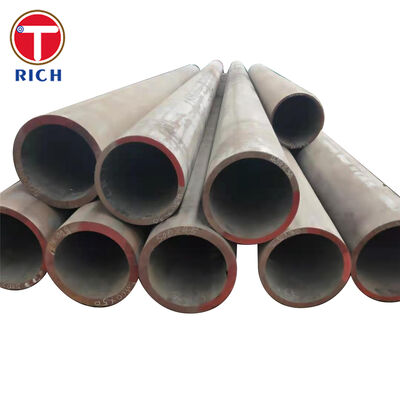
| MOQ: | 1 Tons |
| Price: | 800-1000 USD/Tons |
| Standard Packaging: | In bundles or in wooden boxes. |
| Delivery Period: | 4-8weeks |
| Payment Method: | L/C, D/A, D/P, T/T, Western Union, MoneyGram |
| Supply Capacity: | 60000 Ton/Tons per Year |
![]()
GB/T 34105 seamless steel tubes are designed for load-bearing offshore and marine engineering structures that require controlled strength, low-temperature toughness, weldability, and consistent dimensional performance.
The tubes are suitable for fabricating structural members exposed to wave loading, vibration, impact, cyclic stress, and low-temperature marine environments. Available strength grades range from Q245H to Q690H, with quality classes selected according to the specified Charpy impact test temperature.
Production may include hot rolling, heat treatment, straightening, ultrasonic testing, dimensional inspection, tensile testing, and impact testing. Grade, quality class, dimensions, delivery condition, inspection scope, and certification requirements should be confirmed in the purchase order.
| Item | Available Specification |
|---|---|
| Product | Seamless steel tubes for ocean engineering structures |
| Manufacturing Method | Hot-finished seamless |
| Standard | GB/T 34105-2017 |
| Steel Grades | Q245H, Q290H, Q320H, Q345H, Q360H, Q415H, Q450H, Q485H, Q555H, Q625H and Q690H |
| Quality Classes | B, C, D, E or F, depending on steel grade and required impact temperature |
| Outside Diameter | Typically 114–340 mm; other dimensions subject to production evaluation |
| Wall Thickness | Typically 4.5–40 mm; heavier walls available by technical agreement |
| Length | 1–12 m, fixed length or random length; customized cutting available |
| Outside-Diameter Tolerance | According to GB/T 34105 and the agreed dimensional class |
| Wall-Thickness Tolerance | According to GB/T 34105 and the agreed dimensional class |
| Straightness | Controlled according to the standard and purchase specification |
| End Condition | Plain ends, square cut or bevelled ends |
| Surface Condition | Hot-finished, shot-blasted, shop-primed or coated as specified |
| Heat Treatment | As rolled, normalized, normalized and tempered, or quenched and tempered depending on grade |
| Inspection | Tensile, Charpy impact, dimensional, visual and ultrasonic testing as specified |
| Certification | Inspection certificate with heat number, chemical analysis and mechanical test results |
Dimensions outside the stated production range should be reviewed against the selected grade, wall thickness, heat-treatment route, testing frequency, and minimum order quantity.
The grade designation indicates the nominal minimum yield-strength level. The standard includes structural steel grades from approximately 245 MPa to 690 MPa minimum yield strength, allowing engineers to balance structural capacity, tube weight, weldability, and fabrication cost.
Quality-class suffixes are used to distinguish impact-test requirements. Depending on the selected grade and class, Charpy V-notch testing may be specified at temperatures including 20°C, 0°C, −20°C, −40°C or −60°C.
For offshore projects, the quality class must therefore be stated together with the grade. Ordering “Q345H” without an impact class is not sufficient for confirming low-temperature suitability.
The seamless manufacturing route avoids a longitudinal weld seam. This provides uniform circumferential geometry and makes the tube suitable for structural members subjected to bending, axial loading, torsion, vibration and multi-directional fatigue loading.
Low-carbon and microalloyed compositions are used to achieve the specified strength and toughness. Carbon equivalent, product thickness, heat input, preheating temperature, consumable selection and post-weld procedures should be reviewed before fabrication.
Each production heat can be linked to chemical analysis and mechanical test records. For critical offshore projects, heat-number traceability, tube-by-tube identification, ultrasonic inspection records and inspection certificates can be included in the documentation package.
A common procurement risk is specifying only the strength grade while omitting the required Charpy impact temperature.
Before production, we review:
Design temperature
Required quality class
Tube wall thickness
Heat-treatment condition
Charpy test temperature
Minimum absorbed energy
Project or classification-society requirements
This prevents the supply of a tube that meets room-temperature tensile requirements but does not satisfy the project’s low-temperature toughness requirements.
Mechanical properties, especially yield strength and toughness, may vary with wall thickness and delivery condition.
We match the manufacturing route to the ordered grade:
Normalizing for stable microstructure and toughness
Normalizing and tempering where required
Quenching and tempering for higher-strength grades
Controlled cooling for consistent properties through the wall
Representative mechanical testing based on the agreed inspection lot
The final mill certificate identifies the actual heat-treatment condition and reported test results.
Offshore fabricators often require more than a basic commercial certificate.
Available documentation can include:
Inspection certificate
Heat analysis
Product analysis when specified
Tensile-test report
Charpy impact-test report
Ultrasonic-testing report
Dimensional inspection report
Heat-treatment record
Tube marking and packing list
Third-party inspection endorsement
Material traceability list
Documentation requirements should be stated at the quotation stage to ensure that testing and record retention are included in the production plan.
| Standard System | Relevant Standard or Reference | Application |
|---|---|---|
| GB | GB/T 34105 | Seamless steel tubes specifically for ocean engineering structures |
| GB | GB 712 | Structural steel for ships and offshore engineering; mainly plate, strip and sections |
| ASTM | ASTM A519 | Seamless carbon and alloy steel mechanical tubing; not a direct replacement for GB/T 34105 |
| ASTM | ASTM A106/A106M | Seamless carbon steel pipe for high-temperature service; pressure-piping standard rather than offshore structural tubing |
| EN | EN 10210-1 and EN 10210-2 | Hot-finished structural hollow sections |
| EN | EN 10297-1 | Seamless circular steel tubes for mechanical and general engineering purposes |
| JIS | JIS G 3444 | Carbon steel tubes for general structural purposes |
| GOST | GOST 8732 and GOST 8731 | Hot-deformed seamless steel tubes and associated technical requirements |
GB/T 34105 seamless tubes can be used to manufacture tubular diagonal bracing for offshore platform support structures.
The bracing members transfer axial, bending and cyclic loads generated by:
Wave action
Wind loading
Platform vibration
Equipment operation
Installation loads
Repeated environmental loading
For this application, the purchaser should specify the required grade, quality class, design temperature, dimensions, corrosion allowance, weld procedure, ultrasonic-testing level, coating system and third-party inspection requirements.
The following table provides a practical procurement reference for five commonly specified strength levels. Final acceptance must be based on the ordered grade, quality class, product thickness, heat analysis, applicable table in GB/T 34105-2017, and the mill inspection certificate.
Values are mass fractions in percent.
| Grade | C Max. | Si Max. | Mn Max. | P Max. | S Max. | Nb Max. | V Max. | Ti Max. |
|---|---|---|---|---|---|---|---|---|
| Q245H | 0.18 | 0.50 | 1.40 | 0.030 | 0.025 | 0.050 | 0.100 | 0.050 |
| Q290H | 0.18 | 0.50 | 1.60 | 0.030 | 0.025 | 0.050 | 0.100 | 0.050 |
| Q345H | 0.18 | 0.50 | 1.70 | 0.030 | 0.025 | 0.050 | 0.100 | 0.050 |
| Q415H | 0.18 | 0.50 | 1.70 | 0.025 | 0.020 | 0.070 | 0.120 | 0.050 |
| Q690H | 0.18 | 0.50 | 1.80 | 0.025 | 0.015 | 0.080 | 0.120 | 0.050 |
| Grade | Minimum Yield Strength | Tensile Strength | Minimum Elongation | Typical Delivery Condition |
|---|---|---|---|---|
| Q245H | 245 MPa | 400–520 MPa | 22% | As rolled or normalized |
| Q290H | 290 MPa | 420–540 MPa | 21% | As rolled or normalized |
| Q345H | 345 MPa | 470–630 MPa | 20% | Normalized or equivalent controlled condition |
| Q415H | 415 MPa | 520–680 MPa | 18% | Normalized and tempered or quenched and tempered |
| Q690H | 690 MPa | 770–940 MPa | 14% | Quenched and tempered |
| Quality Class | Typical Charpy Test Temperature |
|---|---|
| B | 20°C |
| C | 0°C |
| D | −20°C |
| E | −40°C |
| F | −60°C |
Depending on the order and grade, inspection may include:
Heat chemical analysis
Product chemical analysis
Tensile testing
Charpy V-notch impact testing
Flattening or bend testing where applicable
Ultrasonic testing
Visual surface inspection
Outside-diameter measurement
Wall-thickness measurement
Length and straightness inspection
End inspection
Marking verification
Third-party inspection
The ultrasonic testing level, test frequency, acceptance criteria and inspection-document type should be specified in the inquiry.
A complete inquiry should include:
Standard: GB/T 34105-2017
Steel grade and quality class
Outside diameter
Wall thickness
Length
Quantity or total weight
Delivery condition
Design temperature
Charpy test temperature and absorbed energy
Dimensional tolerance requirements
Straightness requirements
Ultrasonic-testing requirements
End preparation
Surface protection or coating
Inspection-document type
Third-party or classification-society inspection
Marking and packing requirements
Correct definition of these parameters is essential because nominally similar offshore structural tubes may differ significantly in low-temperature toughness, weldability, dimensional accuracy, inspection scope and documentation.
![]()
![]()
![]()
![]()
A: manufacturer,also can do trading.
A: Generally speaking,it is 10-15 days if the goods are in stock,or it is 30-40 days if the goods are not in stock, it is according to quantity.
A: Yes, we could offer the sample for free charge but need pay the cost of freight.
A: Payment<=2000USD, 100% in advance. Payment>=2000USD, 30% T/T in advance ,balance before shippment.
If you have another question, pls feel free to contact with me.
| MOQ: | 1 Tons |
| Price: | 800-1000 USD/Tons |
| Standard Packaging: | In bundles or in wooden boxes. |
| Delivery Period: | 4-8weeks |
| Payment Method: | L/C, D/A, D/P, T/T, Western Union, MoneyGram |
| Supply Capacity: | 60000 Ton/Tons per Year |
![]()
GB/T 34105 seamless steel tubes are designed for load-bearing offshore and marine engineering structures that require controlled strength, low-temperature toughness, weldability, and consistent dimensional performance.
The tubes are suitable for fabricating structural members exposed to wave loading, vibration, impact, cyclic stress, and low-temperature marine environments. Available strength grades range from Q245H to Q690H, with quality classes selected according to the specified Charpy impact test temperature.
Production may include hot rolling, heat treatment, straightening, ultrasonic testing, dimensional inspection, tensile testing, and impact testing. Grade, quality class, dimensions, delivery condition, inspection scope, and certification requirements should be confirmed in the purchase order.
| Item | Available Specification |
|---|---|
| Product | Seamless steel tubes for ocean engineering structures |
| Manufacturing Method | Hot-finished seamless |
| Standard | GB/T 34105-2017 |
| Steel Grades | Q245H, Q290H, Q320H, Q345H, Q360H, Q415H, Q450H, Q485H, Q555H, Q625H and Q690H |
| Quality Classes | B, C, D, E or F, depending on steel grade and required impact temperature |
| Outside Diameter | Typically 114–340 mm; other dimensions subject to production evaluation |
| Wall Thickness | Typically 4.5–40 mm; heavier walls available by technical agreement |
| Length | 1–12 m, fixed length or random length; customized cutting available |
| Outside-Diameter Tolerance | According to GB/T 34105 and the agreed dimensional class |
| Wall-Thickness Tolerance | According to GB/T 34105 and the agreed dimensional class |
| Straightness | Controlled according to the standard and purchase specification |
| End Condition | Plain ends, square cut or bevelled ends |
| Surface Condition | Hot-finished, shot-blasted, shop-primed or coated as specified |
| Heat Treatment | As rolled, normalized, normalized and tempered, or quenched and tempered depending on grade |
| Inspection | Tensile, Charpy impact, dimensional, visual and ultrasonic testing as specified |
| Certification | Inspection certificate with heat number, chemical analysis and mechanical test results |
Dimensions outside the stated production range should be reviewed against the selected grade, wall thickness, heat-treatment route, testing frequency, and minimum order quantity.
The grade designation indicates the nominal minimum yield-strength level. The standard includes structural steel grades from approximately 245 MPa to 690 MPa minimum yield strength, allowing engineers to balance structural capacity, tube weight, weldability, and fabrication cost.
Quality-class suffixes are used to distinguish impact-test requirements. Depending on the selected grade and class, Charpy V-notch testing may be specified at temperatures including 20°C, 0°C, −20°C, −40°C or −60°C.
For offshore projects, the quality class must therefore be stated together with the grade. Ordering “Q345H” without an impact class is not sufficient for confirming low-temperature suitability.
The seamless manufacturing route avoids a longitudinal weld seam. This provides uniform circumferential geometry and makes the tube suitable for structural members subjected to bending, axial loading, torsion, vibration and multi-directional fatigue loading.
Low-carbon and microalloyed compositions are used to achieve the specified strength and toughness. Carbon equivalent, product thickness, heat input, preheating temperature, consumable selection and post-weld procedures should be reviewed before fabrication.
Each production heat can be linked to chemical analysis and mechanical test records. For critical offshore projects, heat-number traceability, tube-by-tube identification, ultrasonic inspection records and inspection certificates can be included in the documentation package.
A common procurement risk is specifying only the strength grade while omitting the required Charpy impact temperature.
Before production, we review:
Design temperature
Required quality class
Tube wall thickness
Heat-treatment condition
Charpy test temperature
Minimum absorbed energy
Project or classification-society requirements
This prevents the supply of a tube that meets room-temperature tensile requirements but does not satisfy the project’s low-temperature toughness requirements.
Mechanical properties, especially yield strength and toughness, may vary with wall thickness and delivery condition.
We match the manufacturing route to the ordered grade:
Normalizing for stable microstructure and toughness
Normalizing and tempering where required
Quenching and tempering for higher-strength grades
Controlled cooling for consistent properties through the wall
Representative mechanical testing based on the agreed inspection lot
The final mill certificate identifies the actual heat-treatment condition and reported test results.
Offshore fabricators often require more than a basic commercial certificate.
Available documentation can include:
Inspection certificate
Heat analysis
Product analysis when specified
Tensile-test report
Charpy impact-test report
Ultrasonic-testing report
Dimensional inspection report
Heat-treatment record
Tube marking and packing list
Third-party inspection endorsement
Material traceability list
Documentation requirements should be stated at the quotation stage to ensure that testing and record retention are included in the production plan.
| Standard System | Relevant Standard or Reference | Application |
|---|---|---|
| GB | GB/T 34105 | Seamless steel tubes specifically for ocean engineering structures |
| GB | GB 712 | Structural steel for ships and offshore engineering; mainly plate, strip and sections |
| ASTM | ASTM A519 | Seamless carbon and alloy steel mechanical tubing; not a direct replacement for GB/T 34105 |
| ASTM | ASTM A106/A106M | Seamless carbon steel pipe for high-temperature service; pressure-piping standard rather than offshore structural tubing |
| EN | EN 10210-1 and EN 10210-2 | Hot-finished structural hollow sections |
| EN | EN 10297-1 | Seamless circular steel tubes for mechanical and general engineering purposes |
| JIS | JIS G 3444 | Carbon steel tubes for general structural purposes |
| GOST | GOST 8732 and GOST 8731 | Hot-deformed seamless steel tubes and associated technical requirements |
GB/T 34105 seamless tubes can be used to manufacture tubular diagonal bracing for offshore platform support structures.
The bracing members transfer axial, bending and cyclic loads generated by:
Wave action
Wind loading
Platform vibration
Equipment operation
Installation loads
Repeated environmental loading
For this application, the purchaser should specify the required grade, quality class, design temperature, dimensions, corrosion allowance, weld procedure, ultrasonic-testing level, coating system and third-party inspection requirements.
The following table provides a practical procurement reference for five commonly specified strength levels. Final acceptance must be based on the ordered grade, quality class, product thickness, heat analysis, applicable table in GB/T 34105-2017, and the mill inspection certificate.
Values are mass fractions in percent.
| Grade | C Max. | Si Max. | Mn Max. | P Max. | S Max. | Nb Max. | V Max. | Ti Max. |
|---|---|---|---|---|---|---|---|---|
| Q245H | 0.18 | 0.50 | 1.40 | 0.030 | 0.025 | 0.050 | 0.100 | 0.050 |
| Q290H | 0.18 | 0.50 | 1.60 | 0.030 | 0.025 | 0.050 | 0.100 | 0.050 |
| Q345H | 0.18 | 0.50 | 1.70 | 0.030 | 0.025 | 0.050 | 0.100 | 0.050 |
| Q415H | 0.18 | 0.50 | 1.70 | 0.025 | 0.020 | 0.070 | 0.120 | 0.050 |
| Q690H | 0.18 | 0.50 | 1.80 | 0.025 | 0.015 | 0.080 | 0.120 | 0.050 |
| Grade | Minimum Yield Strength | Tensile Strength | Minimum Elongation | Typical Delivery Condition |
|---|---|---|---|---|
| Q245H | 245 MPa | 400–520 MPa | 22% | As rolled or normalized |
| Q290H | 290 MPa | 420–540 MPa | 21% | As rolled or normalized |
| Q345H | 345 MPa | 470–630 MPa | 20% | Normalized or equivalent controlled condition |
| Q415H | 415 MPa | 520–680 MPa | 18% | Normalized and tempered or quenched and tempered |
| Q690H | 690 MPa | 770–940 MPa | 14% | Quenched and tempered |
| Quality Class | Typical Charpy Test Temperature |
|---|---|
| B | 20°C |
| C | 0°C |
| D | −20°C |
| E | −40°C |
| F | −60°C |
Depending on the order and grade, inspection may include:
Heat chemical analysis
Product chemical analysis
Tensile testing
Charpy V-notch impact testing
Flattening or bend testing where applicable
Ultrasonic testing
Visual surface inspection
Outside-diameter measurement
Wall-thickness measurement
Length and straightness inspection
End inspection
Marking verification
Third-party inspection
The ultrasonic testing level, test frequency, acceptance criteria and inspection-document type should be specified in the inquiry.
A complete inquiry should include:
Standard: GB/T 34105-2017
Steel grade and quality class
Outside diameter
Wall thickness
Length
Quantity or total weight
Delivery condition
Design temperature
Charpy test temperature and absorbed energy
Dimensional tolerance requirements
Straightness requirements
Ultrasonic-testing requirements
End preparation
Surface protection or coating
Inspection-document type
Third-party or classification-society inspection
Marking and packing requirements
Correct definition of these parameters is essential because nominally similar offshore structural tubes may differ significantly in low-temperature toughness, weldability, dimensional accuracy, inspection scope and documentation.
![]()
![]()
![]()
![]()
A: manufacturer,also can do trading.
A: Generally speaking,it is 10-15 days if the goods are in stock,or it is 30-40 days if the goods are not in stock, it is according to quantity.
A: Yes, we could offer the sample for free charge but need pay the cost of freight.
A: Payment<=2000USD, 100% in advance. Payment>=2000USD, 30% T/T in advance ,balance before shippment.
If you have another question, pls feel free to contact with me.