| MOQ: | 1 Tons |
| Price: | 800-1000 USD/Tons |
| Standard Packaging: | In bundles or in wooden boxes. |
| Delivery Period: | 20-30days upon products |
| Payment Method: | L/C, D/A, D/P, T/T, Western Union, MoneyGram |
| Supply Capacity: | 60000 Ton/Tons per Year |
![]()
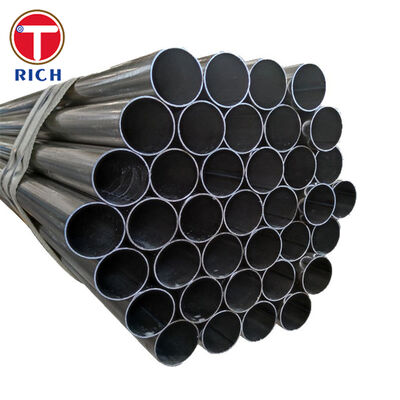
ASTM A523 plain-end electric-resistance-welded steel pipe is specifically manufactured as a pressure-tight conduit for high-pressure pipe-type electrical cable systems. It is supplied in Type E construction, covering NPS 4 through NPS 12, with nominal wall thicknesses from 5.56 mm to 14.27 mm depending on the ordered size.
Unlike general-purpose pressure pipe, ASTM A523 pipe is intended to form a continuous steel enclosure around high-voltage electrical cables and the insulating fluid or gas maintained under pressure. The pipe must therefore provide controlled dimensions, reliable ERW seam integrity, smooth internal surfaces, weldability and resistance to leakage during long-term underground service.
Grade A is normally selected where extensive bending, flaring or belling is required. Grade B provides higher minimum strength while remaining suitable for welding and normal forming operations.
| Item | Available Specification |
|---|---|
| Product | Plain-End Electric-Resistance-Welded Steel Pipe |
| Manufacturing Type | ASTM A523 Type E, electric-resistance welded |
| Material | Carbon steel |
| Standard | ASTM A523/A523M |
| Grades | Grade A and Grade B |
| Nominal Pipe Size | NPS 4–NPS 12 |
| DN Range | DN 100–DN 300 |
| Outside Diameter | 114.3–323.9 mm |
| Nominal Wall Thickness | 5.56–14.27 mm |
| Length | 1–12 m, fixed or random lengths available |
| End Condition | Plain end, square cut |
| Outside-Diameter Tolerance | Controlled according to ASTM A523/A523M purchase requirements |
| Wall-Thickness Tolerance | Actual minimum wall thickness not more than 12.5% below the specified nominal thickness |
| Straightness | Commercially straight; tighter project-specific tolerances available by agreement |
| Surface Condition | Black, bare, oiled or externally coated as specified |
| Internal Surface | Clean and suitable for cable installation and insulating-fluid service |
| Weld Condition | Longitudinal ERW seam with controlled fusion and trimmed internal flash |
| Heat Treatment | Weld seam treatment or full-body heat treatment when specified by the applicable manufacturing procedure |
| Testing | Tensile, flattening and hydrostatic testing |
| Inspection Documents | EN 10204 3.1 inspection certificate available |
| Additional Inspection | Ultrasonic or electromagnetic weld inspection available by purchase agreement |
| Nominal Size | DN | Specified Outside Diameter |
|---|---|---|
| NPS 4 | DN 100 | 114.3 mm |
| NPS 5 | DN 125 | 141.3 mm |
| NPS 6 | DN 150 | 168.3 mm |
| NPS 8 | DN 200 | 219.1 mm |
| NPS 10 | DN 250 | 273.0 mm |
| NPS 12 | DN 300 | 323.9 mm |
Nominal wall thickness is selected according to the pipe size and project design, within the ASTM A523 standard range of 5.56–14.27 mm. Other dimensional combinations may be supplied when they comply with all remaining requirements of ASTM A523/A523M.
The longitudinal seam is produced by electric-resistance welding without the intentional addition of filler metal. Welding heat is generated at the strip edges, followed by mechanical pressure to form a continuous forged weld.
Each pipe is hydrostatically tested to verify pressure containment. The test is intended to identify through-wall leakage, incomplete weld fusion and other pressure-related discontinuities before shipment.
High-pressure cable circuits require a relatively smooth internal passage because electrical cables may be pulled through long pipe sections after field assembly. Excessive internal weld flash, sharp edges, heavy scale or local dimensional restrictions can damage cable sheathing or increase installation resistance.
The internal weld reinforcement is therefore controlled and trimmed according to the manufacturing procedure and purchase specification.
Grade A has a minimum tensile strength of 330 MPa and a minimum yield strength of 205 MPa. Its lower strength level provides greater forming flexibility and makes it the preferred grade for projects requiring extensive bending, flaring or belling.
Grade B has a minimum tensile strength of 415 MPa and a minimum yield strength of 240 MPa. It is selected when higher mechanical strength is required while maintaining weldability and normal cold-forming capability.
The carbon and manganese limits are controlled to provide a practical balance between strength, weldability and forming performance. Plain ends can be prepared for field butt welding using an approved welding procedure suitable for the ordered grade and wall thickness.
The specified outside diameter, wall thickness, end squareness and straightness are controlled to support field alignment. Accurate geometry reduces mismatch between adjoining pipe sections and facilitates consistent circumferential field welds.
For high-pressure cable conduit, visual inspection alone is insufficient because small seam discontinuities may become leakage paths after installation.
Our inspection plan can combine:
Hydrostatic testing of each pipe
Weld-area ultrasonic or electromagnetic inspection
Flattening tests for weld soundness and ductility
Tensile testing by production lot
Visual and dimensional examination of the longitudinal seam
Inspection records and material traceability can be included in the manufacturing documentation package.
Professional cable-system contractors are concerned about internal weld flash, sharp pipe ends, scale and foreign material because these conditions can damage cable jackets during installation.
To reduce this risk, the pipe can be supplied with:
Controlled and trimmed internal ERW flash
Deburred plain ends
Clean internal surfaces
Removal of loose scale and foreign material
Optional internal cleanliness inspection
Protective end caps for transport and storage
Internal-surface acceptance requirements can be defined in the purchase order before production.
Poor end squareness, excessive ovality or inconsistent outside diameter can cause root-gap variation and circumferential weld misalignment in the field.
Our dimensional control includes:
Outside-diameter inspection at multiple pipe positions
Wall-thickness verification
End-squareness inspection
Straightness inspection
End-roundness and ovality checks
Matching and identification of special project lots
Beveling can also be supplied according to an approved field-welding specification, although the standard product is furnished with plain ends.
| Standard | Relevance |
|---|---|
| ASTM A523/A523M | Primary product standard for plain-end seamless and ERW steel pipe used in high-pressure pipe-type cable circuits |
| ASME B36.10M | Reference for standardized carbon-steel pipe dimensions |
| ASTM A530/A530M | General dimensional, testing and workmanship requirements where referenced by the product specification |
| ASTM A53/A53M | General welded and seamless carbon-steel pressure pipe; not a direct replacement for ASTM A523 |
| EN 10217-1 | European welded non-alloy steel tubes for pressure purposes; project equivalence requires engineering review |
| JIS G 3454 | Carbon-steel pipe for pressure service; not a direct equivalent to ASTM A523 |
| GB/T 3091 | Welded steel pipe for low-pressure fluid service; not suitable as an automatic substitute for ASTM A523 |
| GOST 10704 / GOST 10705 | Electrically welded longitudinal steel pipe dimensions and technical requirements; equivalence must be contractually evaluated |
ASTM A523 should not be replaced by a general pressure-pipe standard without approval from the cable-system designer. Its application, forming provisions and testing requirements are specifically associated with high-pressure pipe-type electrical cable circuits.
The pipe is used as the welded steel enclosure for an underground high-pressure oil-filled transmission cable circuit.
Individual pipe lengths are aligned and circumferentially welded in the field to create a continuous pressure-tight conduit. High-voltage electrical cables are then installed inside the pipe, and the completed circuit is filled with pressurized dielectric fluid.
The steel pipe performs several functions:
Contains the pressurized dielectric fluid
Protects the electrical cables from soil loads and mechanical impact
Provides a continuous controlled route for cable installation
Resists external loads during underground service
Supports leak-tight welded joints between pipe sections
Protects the cable system from moisture and environmental exposure
The pipe is not intended to function as the electrical conductor itself and should not be specified as a general oil, gas or process-fluid transmission line without a separate engineering assessment.
| ASTM A523 Grade | Carbon, C | Manganese, Mn | Phosphorus, P | Sulfur, S |
|---|---|---|---|---|
| Grade A | 0.25% max | 0.95% max | 0.035% max | 0.035% max |
| Grade B | 0.30% max | 1.20% max | 0.035% max | 0.035% max |
| ASTM A523 Grade | Minimum Tensile Strength | Minimum Yield Strength | Elongation |
|---|---|---|---|
| Grade A | 330 MPa / 48 ksi | 205 MPa / 30 ksi | Determined according to the ASTM A523 specimen-area equation |
| Grade B | 415 MPa / 60 ksi | 240 MPa / 35 ksi | Determined according to the ASTM A523 specimen-area equation |
![]()
![]()
![]()
![]()
A: manufacturer,also can do trading.
A: Generally speaking,it is 10-15 days if the goods are in stock,or it is 30-40 days if the goods are not in stock, it is according to quantity.
A: Yes, we could offer the sample for free charge but need pay the cost of freight.
A: Payment<=2000USD, 100% in advance. Payment>=2000USD, 30% T/T in advance ,balance before shippment.
If you have another question, pls feel free to contact with me.
| MOQ: | 1 Tons |
| Price: | 800-1000 USD/Tons |
| Standard Packaging: | In bundles or in wooden boxes. |
| Delivery Period: | 20-30days upon products |
| Payment Method: | L/C, D/A, D/P, T/T, Western Union, MoneyGram |
| Supply Capacity: | 60000 Ton/Tons per Year |
![]()
ASTM A523 plain-end electric-resistance-welded steel pipe is specifically manufactured as a pressure-tight conduit for high-pressure pipe-type electrical cable systems. It is supplied in Type E construction, covering NPS 4 through NPS 12, with nominal wall thicknesses from 5.56 mm to 14.27 mm depending on the ordered size.
Unlike general-purpose pressure pipe, ASTM A523 pipe is intended to form a continuous steel enclosure around high-voltage electrical cables and the insulating fluid or gas maintained under pressure. The pipe must therefore provide controlled dimensions, reliable ERW seam integrity, smooth internal surfaces, weldability and resistance to leakage during long-term underground service.
Grade A is normally selected where extensive bending, flaring or belling is required. Grade B provides higher minimum strength while remaining suitable for welding and normal forming operations.
| Item | Available Specification |
|---|---|
| Product | Plain-End Electric-Resistance-Welded Steel Pipe |
| Manufacturing Type | ASTM A523 Type E, electric-resistance welded |
| Material | Carbon steel |
| Standard | ASTM A523/A523M |
| Grades | Grade A and Grade B |
| Nominal Pipe Size | NPS 4–NPS 12 |
| DN Range | DN 100–DN 300 |
| Outside Diameter | 114.3–323.9 mm |
| Nominal Wall Thickness | 5.56–14.27 mm |
| Length | 1–12 m, fixed or random lengths available |
| End Condition | Plain end, square cut |
| Outside-Diameter Tolerance | Controlled according to ASTM A523/A523M purchase requirements |
| Wall-Thickness Tolerance | Actual minimum wall thickness not more than 12.5% below the specified nominal thickness |
| Straightness | Commercially straight; tighter project-specific tolerances available by agreement |
| Surface Condition | Black, bare, oiled or externally coated as specified |
| Internal Surface | Clean and suitable for cable installation and insulating-fluid service |
| Weld Condition | Longitudinal ERW seam with controlled fusion and trimmed internal flash |
| Heat Treatment | Weld seam treatment or full-body heat treatment when specified by the applicable manufacturing procedure |
| Testing | Tensile, flattening and hydrostatic testing |
| Inspection Documents | EN 10204 3.1 inspection certificate available |
| Additional Inspection | Ultrasonic or electromagnetic weld inspection available by purchase agreement |
| Nominal Size | DN | Specified Outside Diameter |
|---|---|---|
| NPS 4 | DN 100 | 114.3 mm |
| NPS 5 | DN 125 | 141.3 mm |
| NPS 6 | DN 150 | 168.3 mm |
| NPS 8 | DN 200 | 219.1 mm |
| NPS 10 | DN 250 | 273.0 mm |
| NPS 12 | DN 300 | 323.9 mm |
Nominal wall thickness is selected according to the pipe size and project design, within the ASTM A523 standard range of 5.56–14.27 mm. Other dimensional combinations may be supplied when they comply with all remaining requirements of ASTM A523/A523M.
The longitudinal seam is produced by electric-resistance welding without the intentional addition of filler metal. Welding heat is generated at the strip edges, followed by mechanical pressure to form a continuous forged weld.
Each pipe is hydrostatically tested to verify pressure containment. The test is intended to identify through-wall leakage, incomplete weld fusion and other pressure-related discontinuities before shipment.
High-pressure cable circuits require a relatively smooth internal passage because electrical cables may be pulled through long pipe sections after field assembly. Excessive internal weld flash, sharp edges, heavy scale or local dimensional restrictions can damage cable sheathing or increase installation resistance.
The internal weld reinforcement is therefore controlled and trimmed according to the manufacturing procedure and purchase specification.
Grade A has a minimum tensile strength of 330 MPa and a minimum yield strength of 205 MPa. Its lower strength level provides greater forming flexibility and makes it the preferred grade for projects requiring extensive bending, flaring or belling.
Grade B has a minimum tensile strength of 415 MPa and a minimum yield strength of 240 MPa. It is selected when higher mechanical strength is required while maintaining weldability and normal cold-forming capability.
The carbon and manganese limits are controlled to provide a practical balance between strength, weldability and forming performance. Plain ends can be prepared for field butt welding using an approved welding procedure suitable for the ordered grade and wall thickness.
The specified outside diameter, wall thickness, end squareness and straightness are controlled to support field alignment. Accurate geometry reduces mismatch between adjoining pipe sections and facilitates consistent circumferential field welds.
For high-pressure cable conduit, visual inspection alone is insufficient because small seam discontinuities may become leakage paths after installation.
Our inspection plan can combine:
Hydrostatic testing of each pipe
Weld-area ultrasonic or electromagnetic inspection
Flattening tests for weld soundness and ductility
Tensile testing by production lot
Visual and dimensional examination of the longitudinal seam
Inspection records and material traceability can be included in the manufacturing documentation package.
Professional cable-system contractors are concerned about internal weld flash, sharp pipe ends, scale and foreign material because these conditions can damage cable jackets during installation.
To reduce this risk, the pipe can be supplied with:
Controlled and trimmed internal ERW flash
Deburred plain ends
Clean internal surfaces
Removal of loose scale and foreign material
Optional internal cleanliness inspection
Protective end caps for transport and storage
Internal-surface acceptance requirements can be defined in the purchase order before production.
Poor end squareness, excessive ovality or inconsistent outside diameter can cause root-gap variation and circumferential weld misalignment in the field.
Our dimensional control includes:
Outside-diameter inspection at multiple pipe positions
Wall-thickness verification
End-squareness inspection
Straightness inspection
End-roundness and ovality checks
Matching and identification of special project lots
Beveling can also be supplied according to an approved field-welding specification, although the standard product is furnished with plain ends.
| Standard | Relevance |
|---|---|
| ASTM A523/A523M | Primary product standard for plain-end seamless and ERW steel pipe used in high-pressure pipe-type cable circuits |
| ASME B36.10M | Reference for standardized carbon-steel pipe dimensions |
| ASTM A530/A530M | General dimensional, testing and workmanship requirements where referenced by the product specification |
| ASTM A53/A53M | General welded and seamless carbon-steel pressure pipe; not a direct replacement for ASTM A523 |
| EN 10217-1 | European welded non-alloy steel tubes for pressure purposes; project equivalence requires engineering review |
| JIS G 3454 | Carbon-steel pipe for pressure service; not a direct equivalent to ASTM A523 |
| GB/T 3091 | Welded steel pipe for low-pressure fluid service; not suitable as an automatic substitute for ASTM A523 |
| GOST 10704 / GOST 10705 | Electrically welded longitudinal steel pipe dimensions and technical requirements; equivalence must be contractually evaluated |
ASTM A523 should not be replaced by a general pressure-pipe standard without approval from the cable-system designer. Its application, forming provisions and testing requirements are specifically associated with high-pressure pipe-type electrical cable circuits.
The pipe is used as the welded steel enclosure for an underground high-pressure oil-filled transmission cable circuit.
Individual pipe lengths are aligned and circumferentially welded in the field to create a continuous pressure-tight conduit. High-voltage electrical cables are then installed inside the pipe, and the completed circuit is filled with pressurized dielectric fluid.
The steel pipe performs several functions:
Contains the pressurized dielectric fluid
Protects the electrical cables from soil loads and mechanical impact
Provides a continuous controlled route for cable installation
Resists external loads during underground service
Supports leak-tight welded joints between pipe sections
Protects the cable system from moisture and environmental exposure
The pipe is not intended to function as the electrical conductor itself and should not be specified as a general oil, gas or process-fluid transmission line without a separate engineering assessment.
| ASTM A523 Grade | Carbon, C | Manganese, Mn | Phosphorus, P | Sulfur, S |
|---|---|---|---|---|
| Grade A | 0.25% max | 0.95% max | 0.035% max | 0.035% max |
| Grade B | 0.30% max | 1.20% max | 0.035% max | 0.035% max |
| ASTM A523 Grade | Minimum Tensile Strength | Minimum Yield Strength | Elongation |
|---|---|---|---|
| Grade A | 330 MPa / 48 ksi | 205 MPa / 30 ksi | Determined according to the ASTM A523 specimen-area equation |
| Grade B | 415 MPa / 60 ksi | 240 MPa / 35 ksi | Determined according to the ASTM A523 specimen-area equation |
![]()
![]()
![]()
![]()
A: manufacturer,also can do trading.
A: Generally speaking,it is 10-15 days if the goods are in stock,or it is 30-40 days if the goods are not in stock, it is according to quantity.
A: Yes, we could offer the sample for free charge but need pay the cost of freight.
A: Payment<=2000USD, 100% in advance. Payment>=2000USD, 30% T/T in advance ,balance before shippment.
If you have another question, pls feel free to contact with me.