| MOQ: | 1 Tons |
| Price: | 800-1000 USD/Tons |
| Standard Packaging: | In bundles or in wooden boxes. |
| Delivery Period: | 20-30days upon products |
| Payment Method: | L/C, D/A, D/P, T/T, Western Union, |
| Supply Capacity: | 60000 Ton/Tons per Year |
![]()
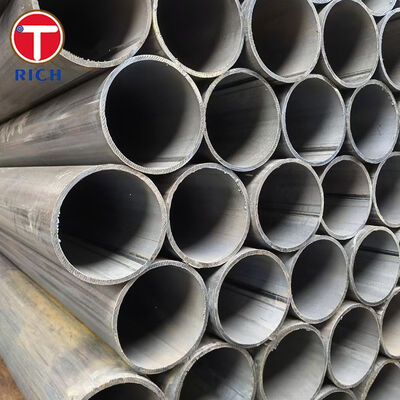
ASTM A587 electric-resistance-welded low-carbon steel pipe is specifically manufactured for process piping applications in the chemical industry where reliable weld integrity, good ductility, flanging capability, and close-radius bending performance are required.
ASTM A587/A587M covers ERW low-carbon steel pipe from NPS 1/2 [DN 15] through NPS 10 [DN 250], together with specified additional sizes. The steel is aluminum-killed low-carbon steel, and the pipe is normalized after welding. Cold-drawn pipe is normalized after the final cold-drawing operation.
A key difference between ASTM A587 and general-purpose welded pipe specifications is its emphasis on forming performance. Pipe supplied to this standard is intended to withstand severe flanging operations in all covered sizes and close-radius bending through NPS 4 [DN 100].
| Item | Specification |
|---|---|
| Product | Electric-Resistance-Welded Low-Carbon Steel Pipe |
| Material | Aluminum-killed low-carbon steel |
| Standard | ASTM A587/A587M |
| Manufacturing Process | Electric Resistance Welding, ERW |
| Size Range | NPS 1/2 to NPS 10 [DN 15 to DN 250], plus specified additional sizes |
| Outside Diameter | Approx. 21.30-273.05 mm for standard NPS 1/2-NPS 10 sizes |
| Wall Thickness | Approx. 2.41-15.60 mm depending on pipe diameter and specified thickness |
| Length | 1-12 m, customizable according to purchase requirements |
| OD Tolerance | Size-dependent according to ASTM A587/A587M dimensional requirements |
| Wall Thickness Tolerance | Size and nominal-thickness dependent according to ASTM A587/A587M |
| Straightness | Maximum deflection 0.76 mm per 0.91 m for pipe below NPS 8; maximum 1.52 mm per 0.91 m for NPS 8 and above |
| Surface Condition | Normalized ERW surface; scale removal, oiling, or specified surface preparation available where required |
| Heat Treatment | Normalized above the upper critical temperature |
| Cold-Drawn Condition | Normalized after the final cold-drawing pass |
| End Condition | Plain end; cut-to-length preparation available |
| Testing | Tensile, flattening, reverse flattening, flange, and nondestructive examination |
| NDT Methods | Eddy-current, ultrasonic, or magnetic flux leakage examination as applicable |
| Inspection Documents | Mill Test Certificate with heat number, chemistry, mechanical properties, dimensions, and inspection results |
ASTM A587 pipe is designed for applications requiring substantially more forming than conventional straight process piping.
The material must be suitable for:
Severe flange-forming operations across the covered size range
Close-radius bending through NPS 4 [DN 100]
Cold flattening without unacceptable cracking or weld failure
Reverse flattening for assessment of weld soundness
This combination is particularly relevant where the finished process line contains formed ends, compact bends, or fabricated connections.
ASTM A587 limits carbon to a maximum of 0.15%.
The controlled carbon level supports the ductility required for bending and flanging operations while reducing the risk of excessive hardness associated with forming and welding.
Manganese is controlled between 0.27% and 0.63%, while phosphorus and sulfur are each limited to 0.035% maximum.
The steel is aluminum killed, with aluminum specified between 0.020% and 0.100%.
Controlled deoxidation contributes to consistent steel quality and helps provide the uniform forming characteristics required for process-pipe fabrication.
Pipe furnished after ERW manufacture is normalized above the upper critical transformation temperature.
For cold-drawn pipe, normalization is performed after the final cold-drawing operation.
Normalization reduces the metallurgical differences created during welding and forming and produces a more uniform microstructure across the pipe body.
The finished pipe must meet the following minimum tensile requirements:
Tensile strength: 330 MPa minimum
Yield strength: 205 MPa minimum
Elongation in 50 mm: 40% minimum
The relatively high minimum elongation requirement is particularly important for flanged and bent chemical-process piping.
One of the main procurement concerns for chemical-process ERW piping is whether the longitudinal weld can withstand subsequent bending and flange forming without cracking.
Production control therefore focuses not only on the external appearance of the weld but also on the metallurgical and mechanical condition of the complete weld zone.
ASTM A587 inspection can include:
Flattening testing
Reverse-flattening testing
Flange testing
Eddy-current testing
Ultrasonic testing
Magnetic flux leakage testing
These examinations provide verification of weld continuity before the pipe enters downstream fabrication.
Chemical-equipment manufacturers frequently perform bending, end forming, and flange-forming operations after receiving the pipe.
For this reason, dimensional inspection alone is insufficient.
ASTM A587 pipe is produced specifically for severe forming applications. Normalized material condition, controlled carbon content, minimum 40% elongation, and forming tests provide a defined technical basis for evaluating whether the pipe is suitable for downstream fabrication.
For projects involving particularly small bend radii or special flange geometries, representative production samples can also be evaluated against the customer's finished-component forming requirements.
Variation between production heats can create problems during automated bending, welding, or process-equipment assembly.
Material traceability can therefore be maintained from incoming steel through ERW production, normalization, inspection, and finished-pipe identification.
Inspection documentation can include:
Heat number
Chemical analysis
Tensile properties
Outside diameter
Wall thickness
Straightness inspection
Heat-treatment condition
Nondestructive examination results
This allows purchasing and quality-control teams to verify material conformity against the purchase order before production use.
| Standard System | Standard / Reference | Description |
|---|---|---|
| ASTM | ASTM A587/A587M | ERW low-carbon steel pipe specifically intended for chemical-industry process lines |
| ASTM | ASTM A530/A530M | General requirements applicable to specialized carbon and alloy steel pipe |
| ASTM | ASTM A751 | Chemical analysis methods and terminology for steel products |
| ASTM | ASTM A370 | Mechanical testing methods for steel products |
| EN | EN 10217-1 | Welded non-alloy steel tubes for pressure purposes; functional comparison only, not a direct ASTM A587 equivalent |
| GOST | GOST 10704 / GOST 10705 | Longitudinal electric-welded steel pipe dimensional and technical references; not direct equivalents |
| JIS | JIS G3452 / JIS G3454 | Carbon steel piping standards used for general or pressure piping; not direct equivalents |
| GB | GB/T 3091 | Welded steel pipe for low-pressure fluid service; not a direct ASTM A587 equivalent |
A representative application is the process-water transfer pipe installed inside a chemical dosing skid.
These assemblies often require compact pipe routing, formed connections, welded branches, and accurately positioned pipe ends within limited equipment space.
ASTM A587 ERW pipe is suitable for this type of fabricated process line because its controlled low-carbon chemistry, normalized condition, minimum 40% elongation, and specified flange and flattening performance support subsequent bending and fabrication.
Actual compatibility with the transported chemical must be verified separately because ASTM A587 defines the steel pipe construction and mechanical requirements but does not establish universal corrosion resistance for all chemical media.
| ASTM A587 Material | C % Max | Mn % | P % Max | S % Max | Al % |
|---|---|---|---|---|---|
| ASTM A587/A587M Low-Carbon Steel | 0.15 | 0.27-0.63 | 0.035 | 0.035 | 0.020-0.100 |
| ASTM A587 Material | Tensile Strength Min | Yield Strength Min | Elongation in 50 mm Min |
|---|---|---|---|
| ASTM A587/A587M Low-Carbon Steel | 330 MPa | 205 MPa | 40% |
| NPS | Outside Diameter | Typical Specified Wall Thickness Range |
|---|---|---|
| 1/2 | 21.30 mm | 2.41-3.84 mm |
| 3/4 | 26.70 mm | 2.51-4.04 mm |
| 1 | 33.40 mm | 2.95-4.70 mm |
| 1 1/4 | 42.16 mm | 3.07-5.00 mm |
| 1 1/2 | 48.30 mm | 3.22-5.21 mm |
| 2 | 60.33 mm | 3.43-5.72 mm |
| 3 | 88.90 mm | 4.80-7.87 mm |
| 4 | 114.30 mm | 5.26-8.87 mm |
| 6 | 168.28 mm | Approx. 6.22-11.33 mm depending on specified series |
| 8 | 219.08 mm | 7.16-13.16 mm |
| 10 | 273.05 mm | 8.10-15.60 mm |
Typical ASTM A587 production inspection includes dimensional verification, material identification, mechanical testing, forming evaluation, and weld examination.
Critical control items include:
Heat-number traceability
Chemical composition verification
Outside-diameter measurement
Wall-thickness measurement
Straightness inspection
Tensile testing
Flattening testing
Reverse-flattening testing
Flange testing
Weld-area inspection
Nondestructive examination
Final visual inspection
ASTM A587 ERW low-carbon steel pipe is therefore most appropriate where a chemical-process piping project requires a combination of controlled low-carbon chemistry, normalized weld condition, high ductility, reliable forming performance, and verifiable ERW weld quality rather than only basic fluid-conveyance capability.
![]()
![]()
![]()
![]()
A: manufacturer,also can do trading.
A: Generally speaking,it is 10-15 days if the goods are in stock,or it is 30-40 days if the goods are not in stock, it is according to quantity.
A: Yes, we could offer the sample for free charge but need pay the cost of freight.
A: Payment<=2000USD, 100% in advance. Payment>=2000USD, 30% T/T in advance ,balance before shippment.
If you have another question, pls feel free to contact with me.
| MOQ: | 1 Tons |
| Price: | 800-1000 USD/Tons |
| Standard Packaging: | In bundles or in wooden boxes. |
| Delivery Period: | 20-30days upon products |
| Payment Method: | L/C, D/A, D/P, T/T, Western Union, |
| Supply Capacity: | 60000 Ton/Tons per Year |
![]()
ASTM A587 electric-resistance-welded low-carbon steel pipe is specifically manufactured for process piping applications in the chemical industry where reliable weld integrity, good ductility, flanging capability, and close-radius bending performance are required.
ASTM A587/A587M covers ERW low-carbon steel pipe from NPS 1/2 [DN 15] through NPS 10 [DN 250], together with specified additional sizes. The steel is aluminum-killed low-carbon steel, and the pipe is normalized after welding. Cold-drawn pipe is normalized after the final cold-drawing operation.
A key difference between ASTM A587 and general-purpose welded pipe specifications is its emphasis on forming performance. Pipe supplied to this standard is intended to withstand severe flanging operations in all covered sizes and close-radius bending through NPS 4 [DN 100].
| Item | Specification |
|---|---|
| Product | Electric-Resistance-Welded Low-Carbon Steel Pipe |
| Material | Aluminum-killed low-carbon steel |
| Standard | ASTM A587/A587M |
| Manufacturing Process | Electric Resistance Welding, ERW |
| Size Range | NPS 1/2 to NPS 10 [DN 15 to DN 250], plus specified additional sizes |
| Outside Diameter | Approx. 21.30-273.05 mm for standard NPS 1/2-NPS 10 sizes |
| Wall Thickness | Approx. 2.41-15.60 mm depending on pipe diameter and specified thickness |
| Length | 1-12 m, customizable according to purchase requirements |
| OD Tolerance | Size-dependent according to ASTM A587/A587M dimensional requirements |
| Wall Thickness Tolerance | Size and nominal-thickness dependent according to ASTM A587/A587M |
| Straightness | Maximum deflection 0.76 mm per 0.91 m for pipe below NPS 8; maximum 1.52 mm per 0.91 m for NPS 8 and above |
| Surface Condition | Normalized ERW surface; scale removal, oiling, or specified surface preparation available where required |
| Heat Treatment | Normalized above the upper critical temperature |
| Cold-Drawn Condition | Normalized after the final cold-drawing pass |
| End Condition | Plain end; cut-to-length preparation available |
| Testing | Tensile, flattening, reverse flattening, flange, and nondestructive examination |
| NDT Methods | Eddy-current, ultrasonic, or magnetic flux leakage examination as applicable |
| Inspection Documents | Mill Test Certificate with heat number, chemistry, mechanical properties, dimensions, and inspection results |
ASTM A587 pipe is designed for applications requiring substantially more forming than conventional straight process piping.
The material must be suitable for:
Severe flange-forming operations across the covered size range
Close-radius bending through NPS 4 [DN 100]
Cold flattening without unacceptable cracking or weld failure
Reverse flattening for assessment of weld soundness
This combination is particularly relevant where the finished process line contains formed ends, compact bends, or fabricated connections.
ASTM A587 limits carbon to a maximum of 0.15%.
The controlled carbon level supports the ductility required for bending and flanging operations while reducing the risk of excessive hardness associated with forming and welding.
Manganese is controlled between 0.27% and 0.63%, while phosphorus and sulfur are each limited to 0.035% maximum.
The steel is aluminum killed, with aluminum specified between 0.020% and 0.100%.
Controlled deoxidation contributes to consistent steel quality and helps provide the uniform forming characteristics required for process-pipe fabrication.
Pipe furnished after ERW manufacture is normalized above the upper critical transformation temperature.
For cold-drawn pipe, normalization is performed after the final cold-drawing operation.
Normalization reduces the metallurgical differences created during welding and forming and produces a more uniform microstructure across the pipe body.
The finished pipe must meet the following minimum tensile requirements:
Tensile strength: 330 MPa minimum
Yield strength: 205 MPa minimum
Elongation in 50 mm: 40% minimum
The relatively high minimum elongation requirement is particularly important for flanged and bent chemical-process piping.
One of the main procurement concerns for chemical-process ERW piping is whether the longitudinal weld can withstand subsequent bending and flange forming without cracking.
Production control therefore focuses not only on the external appearance of the weld but also on the metallurgical and mechanical condition of the complete weld zone.
ASTM A587 inspection can include:
Flattening testing
Reverse-flattening testing
Flange testing
Eddy-current testing
Ultrasonic testing
Magnetic flux leakage testing
These examinations provide verification of weld continuity before the pipe enters downstream fabrication.
Chemical-equipment manufacturers frequently perform bending, end forming, and flange-forming operations after receiving the pipe.
For this reason, dimensional inspection alone is insufficient.
ASTM A587 pipe is produced specifically for severe forming applications. Normalized material condition, controlled carbon content, minimum 40% elongation, and forming tests provide a defined technical basis for evaluating whether the pipe is suitable for downstream fabrication.
For projects involving particularly small bend radii or special flange geometries, representative production samples can also be evaluated against the customer's finished-component forming requirements.
Variation between production heats can create problems during automated bending, welding, or process-equipment assembly.
Material traceability can therefore be maintained from incoming steel through ERW production, normalization, inspection, and finished-pipe identification.
Inspection documentation can include:
Heat number
Chemical analysis
Tensile properties
Outside diameter
Wall thickness
Straightness inspection
Heat-treatment condition
Nondestructive examination results
This allows purchasing and quality-control teams to verify material conformity against the purchase order before production use.
| Standard System | Standard / Reference | Description |
|---|---|---|
| ASTM | ASTM A587/A587M | ERW low-carbon steel pipe specifically intended for chemical-industry process lines |
| ASTM | ASTM A530/A530M | General requirements applicable to specialized carbon and alloy steel pipe |
| ASTM | ASTM A751 | Chemical analysis methods and terminology for steel products |
| ASTM | ASTM A370 | Mechanical testing methods for steel products |
| EN | EN 10217-1 | Welded non-alloy steel tubes for pressure purposes; functional comparison only, not a direct ASTM A587 equivalent |
| GOST | GOST 10704 / GOST 10705 | Longitudinal electric-welded steel pipe dimensional and technical references; not direct equivalents |
| JIS | JIS G3452 / JIS G3454 | Carbon steel piping standards used for general or pressure piping; not direct equivalents |
| GB | GB/T 3091 | Welded steel pipe for low-pressure fluid service; not a direct ASTM A587 equivalent |
A representative application is the process-water transfer pipe installed inside a chemical dosing skid.
These assemblies often require compact pipe routing, formed connections, welded branches, and accurately positioned pipe ends within limited equipment space.
ASTM A587 ERW pipe is suitable for this type of fabricated process line because its controlled low-carbon chemistry, normalized condition, minimum 40% elongation, and specified flange and flattening performance support subsequent bending and fabrication.
Actual compatibility with the transported chemical must be verified separately because ASTM A587 defines the steel pipe construction and mechanical requirements but does not establish universal corrosion resistance for all chemical media.
| ASTM A587 Material | C % Max | Mn % | P % Max | S % Max | Al % |
|---|---|---|---|---|---|
| ASTM A587/A587M Low-Carbon Steel | 0.15 | 0.27-0.63 | 0.035 | 0.035 | 0.020-0.100 |
| ASTM A587 Material | Tensile Strength Min | Yield Strength Min | Elongation in 50 mm Min |
|---|---|---|---|
| ASTM A587/A587M Low-Carbon Steel | 330 MPa | 205 MPa | 40% |
| NPS | Outside Diameter | Typical Specified Wall Thickness Range |
|---|---|---|
| 1/2 | 21.30 mm | 2.41-3.84 mm |
| 3/4 | 26.70 mm | 2.51-4.04 mm |
| 1 | 33.40 mm | 2.95-4.70 mm |
| 1 1/4 | 42.16 mm | 3.07-5.00 mm |
| 1 1/2 | 48.30 mm | 3.22-5.21 mm |
| 2 | 60.33 mm | 3.43-5.72 mm |
| 3 | 88.90 mm | 4.80-7.87 mm |
| 4 | 114.30 mm | 5.26-8.87 mm |
| 6 | 168.28 mm | Approx. 6.22-11.33 mm depending on specified series |
| 8 | 219.08 mm | 7.16-13.16 mm |
| 10 | 273.05 mm | 8.10-15.60 mm |
Typical ASTM A587 production inspection includes dimensional verification, material identification, mechanical testing, forming evaluation, and weld examination.
Critical control items include:
Heat-number traceability
Chemical composition verification
Outside-diameter measurement
Wall-thickness measurement
Straightness inspection
Tensile testing
Flattening testing
Reverse-flattening testing
Flange testing
Weld-area inspection
Nondestructive examination
Final visual inspection
ASTM A587 ERW low-carbon steel pipe is therefore most appropriate where a chemical-process piping project requires a combination of controlled low-carbon chemistry, normalized weld condition, high ductility, reliable forming performance, and verifiable ERW weld quality rather than only basic fluid-conveyance capability.
![]()
![]()
![]()
![]()
A: manufacturer,also can do trading.
A: Generally speaking,it is 10-15 days if the goods are in stock,or it is 30-40 days if the goods are not in stock, it is according to quantity.
A: Yes, we could offer the sample for free charge but need pay the cost of freight.
A: Payment<=2000USD, 100% in advance. Payment>=2000USD, 30% T/T in advance ,balance before shippment.
If you have another question, pls feel free to contact with me.