logo
Products
PRODUCTS DETAILS
Home > Products >
BS 6323-5 Electric Resistance Welded And Induction Welded Steel Tubes

BS 6323-5 Electric Resistance Welded And Induction Welded Steel Tubes

MOQ: 1Ton
Price: 800-1000 USD/Ton
Standard Packaging: In bundles or in wooden boxes.
Delivery Period: 20-30days upon products
Payment Method: L/C, D/A, D/P, T/T
Supply Capacity: 60000 Ton/Tons per Year
Detail Information
Place of Origin
Zhejiang/China
Brand Name
Torich
Certification
ISO9001 ISO 14001 TS16949
Model Number
BS 6323-5
Product Description

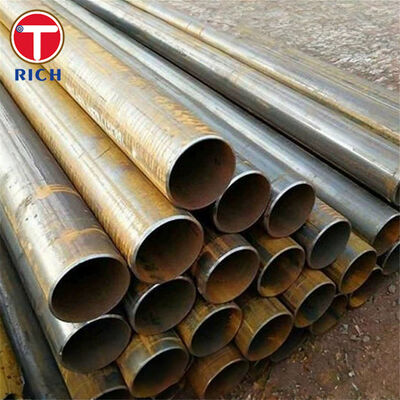
BS 6323-5 Electric Resistance Welded And Induction Welded Steel Tubes


BS 6323-5 Electric Resistance Welded and Induction Welded Steel Tubes

BS 6323-5 electric resistance welded and induction welded steel tubes are carbon steel mechanical tubes manufactured from steel strip by continuous electric resistance welding or high-frequency induction welding. The specification was developed for automobile, mechanical, and general engineering applications where controlled outside diameter, wall thickness, weld quality, mechanical properties, and forming performance are required.

BS 6323-5:1982 covers ERW1, ERW2, ERW3, ERW4, and ERW5 grades with progressively higher strength levels. Tubes may be supplied in as-welded, annealed, or normalized delivery conditions according to the required fabrication process and final mechanical properties.

BS 6323-5:1982 is a withdrawn British Standard. It was withdrawn on 24 June 2003 and superseded principally by BS EN 10305-3, BS EN 10305-5, and BS EN 10296-1. For replacement or legacy automotive components, BS 6323-5 material can still be specified where the original drawing, customer specification, or approved material list requires it.

Specifications

Item Specification
Product Electric Resistance Welded / Induction Welded Steel Tube
Material Carbon Steel
Standard BS 6323-5:1982
Grades ERW1, ERW2, ERW3, ERW4, ERW5
Manufacturing Process Electric resistance welding or induction welding from steel strip
Typical Outside Diameter 6-350 mm
Typical Wall Thickness 1-30 mm
Length 1-12 m, customizable
Cross Section Mainly round; special sections subject to manufacturing agreement
Wall Thickness Tolerance T ≤ 3 mm: ±10%; T > 3 mm: ±8%, excluding the weld zone where applicable
OD Tolerance Depends on diameter and delivery condition; e.g. up to 20 mm OD: ±0.12 mm in KM condition
Straightness For OD >16 mm: maximum 2 mm per metre; total deviation normally not exceeding 0.2% of tube length
Surface Condition Mill finish, lightly oiled, pickled/oiled, or other agreed protective finish
Heat Treatment As-welded, annealed, or normalized according to specified delivery condition
End Condition Plain cut ends; deburred ends available
Inspection Dimensional inspection, tensile testing and applicable technological tests
Inspection Document EN 10204 3.1 available when specified at ordering stage

Main Characteristics

Controlled Dimensional Accuracy

Outside Diameter OD Tolerance
≤20 mm ±0.12 mm
>20-30 mm ±0.15 mm
>30-50 mm ±0.20 mm
>50-70 mm ±0.25 mm
>70-90 mm ±0.30 mm
>90-110 mm ±0.35 mm
>110-130 mm ±0.45 mm
>130-150 mm ±0.55 mm
>150-170 mm ±0.65 mm
>170 mm ±0.75% of OD


Defined Strength Levels

The five ERW grades provide a structured range of mechanical properties. In normalized condition, minimum yield strength ranges from approximately 155 MPa for ERW1 to 340 MPa for ERW5, enabling material selection according to forming load, structural strength, and component design.

Controlled Formability Through Delivery Condition

As-welded tubes provide higher strength generated by the tube-forming process, while annealing or normalizing reduces residual forming stress and improves ductility. This distinction is important where the tube will subsequently undergo bending, end forming, swaging, flattening, welding, or brazing.

Consistent Longitudinal Weld

The strip edges are continuously joined by resistance or induction heating without conventional filler metal. Correct control of strip preparation, welding energy, pressure, and weld-bead removal provides a continuous longitudinal joint suitable for mechanical fabrication.

Our Advantages

1. How Is Weld Integrity Controlled for Components That Require Bending or Flattening?

For automotive and fabricated mechanical parts, nominal tensile strength alone is insufficient. A tube may meet chemistry requirements while still failing during bending if weld quality or heat input is inconsistent.

Production can therefore be controlled through strip-edge preparation, welding-current monitoring, weld-bead control, dimensional inspection, and representative flattening or forming tests. For parts involving severe deformation, the intended bending radius and subsequent forming operation should be supplied before production so that the appropriate grade and delivery condition can be selected.

2. How Are Dimensional Changes After Annealing or Normalizing Managed?

Heat treatment can change tube diameter, ovality, straightness, and mechanical properties. This is particularly important for buyers machining the tube or inserting it into closely toleranced assemblies.

Dimensions should therefore be specified together with the required delivery condition. KM as-welded tubes can achieve tighter OD tolerances, while GKM/GZF or NKM/NZF heat-treated tubes are assessed using the tolerance class applicable to the final heat-treated condition. Final OD, wall thickness, straightness, and length inspection is performed after the specified thermal processing rather than relying only on pre-treatment dimensions.

3. How Can Legacy BS 6323-5 Requirements Be Managed in Current Projects?

BS 6323-5:1982 has been withdrawn, but many established automotive and machinery drawings continue to reference ERW1-ERW5 grades.

For legacy orders, the material specification should remain traceable to BS 6323-5 when contractually required. For new designs, BS EN 10305-3, BS EN 10305-5, or BS EN 10296-1 should be evaluated depending on tube shape, dimensional precision, delivery condition, and intended application. Grade substitution should not be based only on tensile strength; chemistry, yield strength, elongation, tolerances, heat treatment, and test requirements should also be reviewed.

Execution Standards

Standard System Relevant Standard Scope
BS BS 6323-5 ERW and induction welded steel tubes for automobile, mechanical and general engineering purposes
EN EN 10305-3 Welded cold-sized precision steel tubes
EN EN 10305-5 Welded and cold-sized square and rectangular precision steel tubes
EN EN 10296-1 Welded circular steel tubes for mechanical and general engineering purposes
ASTM ASTM A513 Electric-resistance-welded carbon and alloy steel mechanical tubing
JIS JIS G3445 Carbon steel tubes for machine structural purposes
GB GB/T 6728 Cold-formed hollow structural steel sections; used where applicable to welded structural sections
GOST GOST 10704 / GOST 10705 Longitudinal electric-welded steel tubes; dimensional and technical requirements


Application

Automotive Seat Frame Cross Tube

A specific application is the tubular cross member used in an automotive seat frame.

The component requires a controlled outside diameter for fixture positioning and mating parts, sufficient elongation for bending and end forming, repeatable weld integrity during deformation, and adequate tensile and yield strength to withstand service loads.

Lower- and medium-strength BS 6323-5 grades such as ERW1, ERW2, or ERW3 may be selected depending on the seat structure design, tube diameter, wall thickness, bending radius, and required post-forming strength. Annealed or normalized delivery conditions can be considered where severe forming is required.

Chemical Composition

Grade C Max. % Si Max. % Mn Max. % P Max. % S Max. %
ERW1 0.13 0.60 0.050 0.050
ERW2 0.16 0.70 0.050 0.050
ERW3 0.20 0.35 0.90 0.050 0.050
ERW4 0.25 0.35 1.20 0.050 0.050
ERW5 0.23 0.50 1.50 0.050 0.050


Mechanical Properties


Grade Minimum Yield Strength Re, MPa Minimum Tensile Strength Rm, MPa Minimum Elongation A, %
ERW1 155 280 25
ERW2 195 320 25
ERW3 215 360 24
ERW4 235 410 22
ERW5 340 490 20

For comparison, the KM as-welded condition provides different mechanical-property levels because of the forming and welding process.

Grade KM Minimum Yield Strength, MPa KM Minimum Tensile Strength, MPa Minimum Elongation D/t ≤20, % Minimum Elongation D/t >20, %
ERW1 200 300 10 20
ERW2 250 340 8 15
ERW3 300 400 7 12
ERW4 350 450 6 10
ERW5 420 420 6 8


BS 6323-5 Electric Resistance Welded And Induction Welded Steel Tubes


BS 6323-5 Electric Resistance Welded And Induction Welded Steel Tubes     BS 6323-5 Electric Resistance Welded And Induction Welded Steel Tubes


BS 6323-5 Electric Resistance Welded And Induction Welded Steel Tubes     BS 6323-5 Electric Resistance Welded And Induction Welded Steel Tubes

BS 6323-5 Electric Resistance Welded And Induction Welded Steel Tubes

BS 6323-5 Electric Resistance Welded And Induction Welded Steel Tubes


Q: Are you trading company or manufacturer ?

A: manufacturer,also can do trading.


Q: How long is your delivery time?

A: Generally speaking,it is 10-15 days if the goods are in stock,or it is 30-40 days if the goods are not in stock, it is according to quantity.


Q: Do you provide samples? is it free or extra ?

A: Yes, we could offer the sample for free charge but need pay the cost of freight.


Q: What is your terms of payment ?

A: Payment<=2000USD, 100% in advance. Payment>=2000USD, 30% T/T in advance ,balance before shippment.

If you have another question, pls feel free to contact with me.

Products
PRODUCTS DETAILS
BS 6323-5 Electric Resistance Welded And Induction Welded Steel Tubes
MOQ: 1Ton
Price: 800-1000 USD/Ton
Standard Packaging: In bundles or in wooden boxes.
Delivery Period: 20-30days upon products
Payment Method: L/C, D/A, D/P, T/T
Supply Capacity: 60000 Ton/Tons per Year
Detail Information
Place of Origin
Zhejiang/China
Brand Name
Torich
Certification
ISO9001 ISO 14001 TS16949
Model Number
BS 6323-5
Minimum Order Quantity:
1Ton
Price:
800-1000 USD/Ton
Packaging Details:
In bundles or in wooden boxes.
Delivery Time:
20-30days upon products
Payment Terms:
L/C, D/A, D/P, T/T
Supply Ability:
60000 Ton/Tons per Year
Product Description

BS 6323-5 Electric Resistance Welded And Induction Welded Steel Tubes


BS 6323-5 Electric Resistance Welded and Induction Welded Steel Tubes

BS 6323-5 electric resistance welded and induction welded steel tubes are carbon steel mechanical tubes manufactured from steel strip by continuous electric resistance welding or high-frequency induction welding. The specification was developed for automobile, mechanical, and general engineering applications where controlled outside diameter, wall thickness, weld quality, mechanical properties, and forming performance are required.

BS 6323-5:1982 covers ERW1, ERW2, ERW3, ERW4, and ERW5 grades with progressively higher strength levels. Tubes may be supplied in as-welded, annealed, or normalized delivery conditions according to the required fabrication process and final mechanical properties.

BS 6323-5:1982 is a withdrawn British Standard. It was withdrawn on 24 June 2003 and superseded principally by BS EN 10305-3, BS EN 10305-5, and BS EN 10296-1. For replacement or legacy automotive components, BS 6323-5 material can still be specified where the original drawing, customer specification, or approved material list requires it.

Specifications

Item Specification
Product Electric Resistance Welded / Induction Welded Steel Tube
Material Carbon Steel
Standard BS 6323-5:1982
Grades ERW1, ERW2, ERW3, ERW4, ERW5
Manufacturing Process Electric resistance welding or induction welding from steel strip
Typical Outside Diameter 6-350 mm
Typical Wall Thickness 1-30 mm
Length 1-12 m, customizable
Cross Section Mainly round; special sections subject to manufacturing agreement
Wall Thickness Tolerance T ≤ 3 mm: ±10%; T > 3 mm: ±8%, excluding the weld zone where applicable
OD Tolerance Depends on diameter and delivery condition; e.g. up to 20 mm OD: ±0.12 mm in KM condition
Straightness For OD >16 mm: maximum 2 mm per metre; total deviation normally not exceeding 0.2% of tube length
Surface Condition Mill finish, lightly oiled, pickled/oiled, or other agreed protective finish
Heat Treatment As-welded, annealed, or normalized according to specified delivery condition
End Condition Plain cut ends; deburred ends available
Inspection Dimensional inspection, tensile testing and applicable technological tests
Inspection Document EN 10204 3.1 available when specified at ordering stage

Main Characteristics

Controlled Dimensional Accuracy

Outside Diameter OD Tolerance
≤20 mm ±0.12 mm
>20-30 mm ±0.15 mm
>30-50 mm ±0.20 mm
>50-70 mm ±0.25 mm
>70-90 mm ±0.30 mm
>90-110 mm ±0.35 mm
>110-130 mm ±0.45 mm
>130-150 mm ±0.55 mm
>150-170 mm ±0.65 mm
>170 mm ±0.75% of OD


Defined Strength Levels

The five ERW grades provide a structured range of mechanical properties. In normalized condition, minimum yield strength ranges from approximately 155 MPa for ERW1 to 340 MPa for ERW5, enabling material selection according to forming load, structural strength, and component design.

Controlled Formability Through Delivery Condition

As-welded tubes provide higher strength generated by the tube-forming process, while annealing or normalizing reduces residual forming stress and improves ductility. This distinction is important where the tube will subsequently undergo bending, end forming, swaging, flattening, welding, or brazing.

Consistent Longitudinal Weld

The strip edges are continuously joined by resistance or induction heating without conventional filler metal. Correct control of strip preparation, welding energy, pressure, and weld-bead removal provides a continuous longitudinal joint suitable for mechanical fabrication.

Our Advantages

1. How Is Weld Integrity Controlled for Components That Require Bending or Flattening?

For automotive and fabricated mechanical parts, nominal tensile strength alone is insufficient. A tube may meet chemistry requirements while still failing during bending if weld quality or heat input is inconsistent.

Production can therefore be controlled through strip-edge preparation, welding-current monitoring, weld-bead control, dimensional inspection, and representative flattening or forming tests. For parts involving severe deformation, the intended bending radius and subsequent forming operation should be supplied before production so that the appropriate grade and delivery condition can be selected.

2. How Are Dimensional Changes After Annealing or Normalizing Managed?

Heat treatment can change tube diameter, ovality, straightness, and mechanical properties. This is particularly important for buyers machining the tube or inserting it into closely toleranced assemblies.

Dimensions should therefore be specified together with the required delivery condition. KM as-welded tubes can achieve tighter OD tolerances, while GKM/GZF or NKM/NZF heat-treated tubes are assessed using the tolerance class applicable to the final heat-treated condition. Final OD, wall thickness, straightness, and length inspection is performed after the specified thermal processing rather than relying only on pre-treatment dimensions.

3. How Can Legacy BS 6323-5 Requirements Be Managed in Current Projects?

BS 6323-5:1982 has been withdrawn, but many established automotive and machinery drawings continue to reference ERW1-ERW5 grades.

For legacy orders, the material specification should remain traceable to BS 6323-5 when contractually required. For new designs, BS EN 10305-3, BS EN 10305-5, or BS EN 10296-1 should be evaluated depending on tube shape, dimensional precision, delivery condition, and intended application. Grade substitution should not be based only on tensile strength; chemistry, yield strength, elongation, tolerances, heat treatment, and test requirements should also be reviewed.

Execution Standards

Standard System Relevant Standard Scope
BS BS 6323-5 ERW and induction welded steel tubes for automobile, mechanical and general engineering purposes
EN EN 10305-3 Welded cold-sized precision steel tubes
EN EN 10305-5 Welded and cold-sized square and rectangular precision steel tubes
EN EN 10296-1 Welded circular steel tubes for mechanical and general engineering purposes
ASTM ASTM A513 Electric-resistance-welded carbon and alloy steel mechanical tubing
JIS JIS G3445 Carbon steel tubes for machine structural purposes
GB GB/T 6728 Cold-formed hollow structural steel sections; used where applicable to welded structural sections
GOST GOST 10704 / GOST 10705 Longitudinal electric-welded steel tubes; dimensional and technical requirements


Application

Automotive Seat Frame Cross Tube

A specific application is the tubular cross member used in an automotive seat frame.

The component requires a controlled outside diameter for fixture positioning and mating parts, sufficient elongation for bending and end forming, repeatable weld integrity during deformation, and adequate tensile and yield strength to withstand service loads.

Lower- and medium-strength BS 6323-5 grades such as ERW1, ERW2, or ERW3 may be selected depending on the seat structure design, tube diameter, wall thickness, bending radius, and required post-forming strength. Annealed or normalized delivery conditions can be considered where severe forming is required.

Chemical Composition

Grade C Max. % Si Max. % Mn Max. % P Max. % S Max. %
ERW1 0.13 0.60 0.050 0.050
ERW2 0.16 0.70 0.050 0.050
ERW3 0.20 0.35 0.90 0.050 0.050
ERW4 0.25 0.35 1.20 0.050 0.050
ERW5 0.23 0.50 1.50 0.050 0.050


Mechanical Properties


Grade Minimum Yield Strength Re, MPa Minimum Tensile Strength Rm, MPa Minimum Elongation A, %
ERW1 155 280 25
ERW2 195 320 25
ERW3 215 360 24
ERW4 235 410 22
ERW5 340 490 20

For comparison, the KM as-welded condition provides different mechanical-property levels because of the forming and welding process.

Grade KM Minimum Yield Strength, MPa KM Minimum Tensile Strength, MPa Minimum Elongation D/t ≤20, % Minimum Elongation D/t >20, %
ERW1 200 300 10 20
ERW2 250 340 8 15
ERW3 300 400 7 12
ERW4 350 450 6 10
ERW5 420 420 6 8


BS 6323-5 Electric Resistance Welded And Induction Welded Steel Tubes


BS 6323-5 Electric Resistance Welded And Induction Welded Steel Tubes     BS 6323-5 Electric Resistance Welded And Induction Welded Steel Tubes


BS 6323-5 Electric Resistance Welded And Induction Welded Steel Tubes     BS 6323-5 Electric Resistance Welded And Induction Welded Steel Tubes

BS 6323-5 Electric Resistance Welded And Induction Welded Steel Tubes

BS 6323-5 Electric Resistance Welded And Induction Welded Steel Tubes


Q: Are you trading company or manufacturer ?

A: manufacturer,also can do trading.


Q: How long is your delivery time?

A: Generally speaking,it is 10-15 days if the goods are in stock,or it is 30-40 days if the goods are not in stock, it is according to quantity.


Q: Do you provide samples? is it free or extra ?

A: Yes, we could offer the sample for free charge but need pay the cost of freight.


Q: What is your terms of payment ?

A: Payment<=2000USD, 100% in advance. Payment>=2000USD, 30% T/T in advance ,balance before shippment.

If you have another question, pls feel free to contact with me.