| MOQ: | 1Ton |
| Price: | 800-1000 USD/Ton |
| Standard Packaging: | In bundles or in wooden boxes. |
| Delivery Period: | 20-30days upon products |
| Payment Method: | L/C, D/A, D/P, T/T |
| Supply Capacity: | 60000 Ton/Tons per Year |
![]()
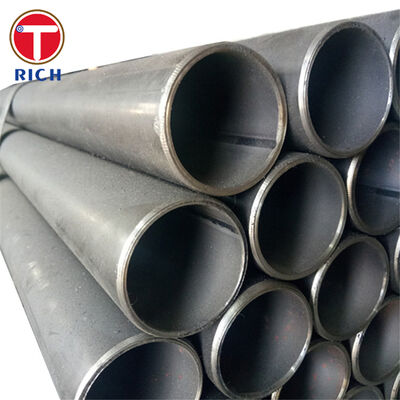
TORICH supplies welded weathering steel tubes for structural applications in accordance with YB/T 4112-2013, the Chinese metallurgical industry standard for welded steel tubes with atmospheric corrosion resistance. These tubes are designed for load-bearing steel structures exposed to outdoor environments, combining specified mechanical strength with improved resistance to atmospheric corrosion.
YB/T 4112-2013 covers longitudinally welded weathering steel tubes for structural columns, towers, supports, and lattice structures. The standard specifies dimensional tolerances, chemical composition, mechanical properties, manufacturing requirements, inspection procedures, and product identification.
Compared with conventional structural carbon steel tubes, weathering steel contains controlled alloying elements such as copper, chromium, nickel, and phosphorus to improve atmospheric corrosion resistance under suitable exposure conditions.
|
Parameter |
Specification |
|---|---|
| Product Name | Welded Weathering Steel Tube |
| Main Standard | YB/T 4112-2013 |
| Material | Low-Alloy Atmospheric Corrosion-Resistant Structural Steel |
| Steel Grades | Q235NH, Q295GNH, Q310GNH, Q355GNH, Q355NH; other grades subject to confirmation |
| Manufacturing Process | Longitudinal electric-resistance welding (ERW) or submerged arc welding (SAW), depending on tube dimensions |
| Tube Shape | Round Structural Steel Tube |
| Outside Diameter (OD) | Selected according to GB/T 21835 and the approved project specification |
| Wall Thickness (WT) | According to GB/T 21835 and applicable manufacturing limits |
| Length | Typical 3–12.5 m; customized cut lengths of 1–12 m subject to agreement |
| Dimensional Tolerance | According to YB/T 4112-2013; tighter tolerances subject to technical agreement |
| Straightness | According to YB/T 4112-2013 or additional drawing requirements |
| Surface Condition | Natural mill finish; surface cleaning or protective coating upon request |
| Heat Treatment | Normally supplied in the welded condition; additional treatment subject to the manufacturing procedure and purchase specification |
| Inspection | Chemical analysis, tensile testing, dimensional inspection, surface examination, and specified weld testing |
| Quality Documentation | Inspection reports and material certificates; EN 10204 Type 3.1 certification when agreed |
Dimensional clarification: YB/T 4112-2013 uses the applicable welded steel tube dimensional series referenced in GB/T 21835. The maximum and minimum available OD and wall thickness must be confirmed for the selected manufacturing process. Precision tolerances should not be assumed without an approved drawing or technical agreement.
1. Defined Structural Strength
For the five representative grades listed below, the minimum yield strength ranges from 235 MPa to 355 MPa at wall thicknesses up to 16 mm. The corresponding specified tensile strength ranges extend from 360 MPa to 630 MPa, depending on the material grade.
These values allow structural designers to select the material according to the required load-bearing capacity rather than relying on a generic welded steel tube classification.
2. Controlled Atmospheric Corrosion Resistance
The selected weathering steel grades use copper, chromium, nickel, and other alloying elements to improve atmospheric corrosion performance.
For example:
Q295GNH: Cu 0.25–0.45%, Cr 0.30–0.65%, P 0.07–0.12%.
Q355GNH: Cu 0.25–0.55%, Cr 0.30–1.25%, P 0.07–0.15%.
Q355NH: Cu 0.25–0.55%, Cr 0.40–0.80%, P ≤0.030%.
Under suitable atmospheric exposure, these alloying elements support the formation of a more protective corrosion-product layer than that normally developed on conventional carbon steel.
3. Welded Structural Manufacturing
YB/T 4112-2013 covers longitudinally welded steel tubes and includes requirements applicable to electric-resistance and submerged arc welding processes.
Weld seam quality is important because the tube may be subjected to axial loading, bending, and structural connection stresses. Welding methods, inspection requirements, and any subsequent fabrication should be selected according to the steel grade and structural design.
4. Grade-Specific Weldability
The GNH and NH grades have different chemical composition limits, particularly for phosphorus and manganese.
For example, Q355GNH permits phosphorus from 0.07% to 0.15%, while Q355NH limits phosphorus to 0.030%.
Consequently, the two grades should not be treated as interchangeable solely because they share a nominal minimum yield strength of 355 MPa. Welding procedure qualification and project requirements must also be considered.
Procurement concern: How can the correct weathering steel grade be verified before production?
TORICH supports grade-specific material verification through chemical composition records and material traceability.
The material documentation can identify the steel grade, heat number, chemical analysis results, and relevant mechanical test results. Particular attention is given to copper, chromium, nickel, and phosphorus, which distinguish weathering steel grades from ordinary structural carbon steel.
This supports verification against the purchase specification and reduces the risk of supplying a material with similar strength but different corrosion-related properties.
Engineering concern: How can welded tube quality be controlled before structural fabrication?
TORICH can establish project-specific inspection requirements covering weld seams, outside diameter, wall thickness, straightness, and surface condition.
Electric-resistance or submerged arc welding is selected according to the manufacturing requirements. Where specified, additional nondestructive examination can be included in the inspection plan.
Inspection results are checked against the approved drawing and agreed acceptance criteria, helping identify dimensional or welding-related nonconformities before the tubes enter subsequent fabrication.
Design concern: Can weathering steel tubes be used without protective coating in every outdoor environment?
Weathering steel depends on suitable atmospheric conditions to develop its protective surface layer. Continuous moisture, salt accumulation, and poorly drained locations can interfere with this process.
TORICH considers the intended service environment when reviewing material and surface-treatment requirements.
For locations exposed to persistent moisture or high chloride concentrations, additional protective coating or a different material specification may be necessary. This avoids assuming that atmospheric corrosion resistance eliminates all corrosion risks.
YB/T 4112-2013 is the primary product standard for this steel tube. The following international specifications provide related technical references.
|
Standard System |
Standard |
Scope |
|---|---|---|
| China - YB | YB/T 4112-2013 | Welded steel tubes with atmospheric corrosion resistance for structural purposes |
| China - GB | GB/T 4171-2008 | Atmospheric corrosion-resistant structural steel grades and chemical requirements |
| China - GB | GB/T 21835-2008 | Dimensions and mass per unit length of welded steel tubes |
| ASTM | ASTM A847/A847M-26 | Cold-formed structural tubing with improved atmospheric corrosion resistance |
| EN | EN 10219-3:2020 | Technical delivery conditions for high-strength and weather-resistant cold-formed welded structural hollow sections |
| JIS | JIS G 3114:2022 | Hot-rolled atmospheric corrosion-resistant steel for welded structures |
| GOST | GOST 10705-80 | Technical requirements for longitudinally electric-welded steel tubes |
Important: These standards are related but not automatically equivalent. JIS G 3114 specifies hot-rolled steel products rather than finished welded tubes, while GOST 10705 does not by itself establish the same weathering steel grade requirements as YB/T 4112. Any cross-standard supply must be evaluated against the complete chemical, mechanical, dimensional, and testing requirements.
YB/T 4112 welded weathering steel tubes can be used to manufacture tubular support columns for outdoor electrical transmission towers.
These components require structural strength to withstand the design loads while maintaining acceptable atmospheric corrosion performance throughout their intended service life.
For this application, the material specification must account for the column loading, wall thickness, welded connections, and environmental exposure.
Q355NH is one candidate grade for a welded structural support column when a minimum yield strength of 355 MPa is required at wall thicknesses up to 16 mm. Final grade selection must consider the structural calculation, weldability, impact requirements, and service environment.
The following table presents the nominal chemical composition limits for five weathering steel grades associated with YB/T 4112-2013 and GB/T 4171-2008.
Chemical Composition (% by Mass)
|
Grade |
C |
Si |
Mn |
P |
S |
Cr |
Ni |
Cu |
|---|---|---|---|---|---|---|---|---|
| Q235NH | ≤0.13 | 0.10–0.40 | 0.20–0.60 | ≤0.030 | ≤0.030 | 0.40–0.80 | ≤0.65 | 0.25–0.55 |
| Q295GNH | ≤0.12 | 0.10–0.40 | 0.20–0.50 | 0.07–0.12 | ≤0.020 | 0.30–0.65 | 0.25–0.50 | 0.25–0.45 |
| Q310GNH | ≤0.12 | 0.25–0.75 | 0.20–0.50 | 0.07–0.12 | ≤0.020 | 0.30–1.25 | ≤0.65 | 0.25–0.50 |
| Q355GNH | ≤0.12 | 0.25–0.75 | ≤1.00 | 0.07–0.15 | ≤0.020 | 0.30–1.25 | ≤0.65 | 0.25–0.55 |
| Q355NH | ≤0.16 | ≤0.50 | 0.50–1.50 | ≤0.030 | ≤0.030 | 0.40–0.80 | ≤0.65 | 0.25–0.55 |
Notes:
The values represent chemical composition limits for heat analysis. Product analysis tolerances shall follow the applicable standard.
Additional alloying elements, including Nb, V, Ti, Mo, and Zr, may be permitted within the specified requirements.
Certain composition limits may be adjusted by agreement where explicitly permitted by the material standard.
Actual chemical composition shall be verified through the material inspection certificate.
The following mechanical properties are published reference values associated with YB/T 4112-2013 for the selected grades at wall thicknesses not exceeding 16 mm.
|
Steel Grade |
Wall Thickness (mm) |
Yield Strength (MPa), Min. |
Tensile Strength (MPa) |
Elongation (%), Min. |
|---|---|---|---|---|
| Q235NH | ≤16 | 235 | 360–510 | 21 |
| Q295GNH | ≤16 | 295 | 430–560 | 20 |
| Q310GNH | ≤16 | 310 | 450–590 | 20 |
| Q355GNH | ≤16 | 355 | 490–630 | 18 |
| Q355NH | ≤16 | 355 | 490–630 | 18 |
![]()
![]()
![]()
![]()
A: manufacturer,also can do trading.
A: Generally speaking,it is 10-15 days if the goods are in stock,or it is 30-40 days if the goods are not in stock, it is according to quantity.
A: Yes, we could offer the sample for free charge but need pay the cost of freight.
A: Payment<=2000USD, 100% in advance. Payment>=2000USD, 30% T/T in advance ,balance before shippment.
If you have another question, pls feel free to contact with me.