logo
Products
PRODUCTS DETAILS
Home > Products >
YB 4103 10# Welded Steel Tubes For Heat-Exchanger

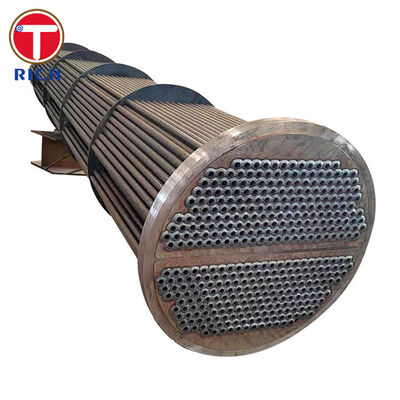
YB 4103 10# Welded Steel Tubes For Heat-Exchanger

MOQ: 1Ton
Price: 800-1000 USD/Ton
Standard Packaging: In bundles or in wooden boxes.
Delivery Period: 20-30days upon products
Payment Method: L/C, D/A, D/P, T/T
Supply Capacity: 60000 Ton/Tons per Year
Detail Information
Place of Origin
Zhejiang/China
Brand Name
TORICH
Certification
ISO9004 ISO14001
Model Number
YB 4103
Product Name:
Welded Carbon Steel Heat Exchanger Tube
Material:
Low-Carbon Steel
Steel Grade:
10 (10# Steel)
Outside Diameter:
19–57 Mm In Historical Nominal Sizes
Wall Thickness:
2.0–5.0 Mm, Subject To The Specified OD And Wall-thickness Combinations
Length:
4,000–12,000 Mm Under The Historical Standard; Custom Cut Lengths Of 1,000–12,000 Mm By Agreement
Heat Treatment:
Whole-tube Heat Treatment Under Controlled Conditions According To The Specified Delivery Condition
Inspection:
Chemical Analysis, Tensile Testing, Flattening, Flaring, Hardness Testing, Dimensional Inspection, And Applicable Nondestructive Testing
Product Description

YB 4103 10# Welded Steel Tubes For Heat-Exchanger


YB 4103 Grade 10 Welded Carbon Steel Tubes for Heat Exchangers

YB 4103 Grade 10 Welded Steel Tubes are electric resistance welded (ERW) carbon steel tubes designed for heat exchangers, condensers, and similar heat-transfer equipment. Manufactured from low-carbon Grade 10 steel, these tubes provide controlled mechanical properties, good ductility, and weldability for the fabrication of tubular heat-transfer components.

YB 4103-2000 was developed for equipment operating within a temperature range of -19°C to 475°C and a maximum design pressure of 6.4 MPa. These values define the historical standard's application scope rather than the allowable operating conditions of every tube or heat exchanger.

Standard Status: YB 4103-2000 has been withdrawn. For new projects, GB/T 28413-2012, the current Chinese national standard for welded carbon steel tubes used in boilers and heat exchangers, should be considered where applicable. Products ordered to the historical YB 4103 specification require explicit agreement on the applicable technical requirements.

1. Product Specifications

Parameter

Specification

Product Name Welded Carbon Steel Heat Exchanger Tube
Historical Standard YB 4103-2000
Material Low-Carbon Steel
Steel Grade 10 (10# Steel)
Manufacturing Process Electric Resistance Welding (ERW); welded and cold-drawn tubing by agreement
Outside Diameter 19–57 mm in historical nominal sizes
Wall Thickness 2.0–5.0 mm, subject to the specified OD and wall-thickness combinations
Length 4,000–12,000 mm under the historical standard; custom cut lengths of 1,000–12,000 mm by agreement
Outside Diameter Tolerance According to YB 4103-2000 Table 2, dependent on tube diameter and manufacturing process
Wall Thickness Tolerance According to the applicable historical tolerance table; special tolerances by agreement
Straightness Maximum deviation of 1.5 mm/m
Weld Seam Longitudinal ERW seam with controlled internal and external weld flash
Internal Weld Bead Height Maximum 0.25 mm under the historical specification
Surface Condition Clean, smooth surface; scale-free heat-treated finish where specified
Heat Treatment Whole-tube heat treatment under controlled conditions according to the specified delivery condition
Tube Ends Plain, square-cut, deburred; other end preparations available
Inspection Chemical analysis, tensile testing, flattening, flaring, hardness testing, dimensional inspection, and applicable nondestructive testing
Documentation Material Test Certificate; EN 10204 3.1 documentation available by agreement

Note: The dimensional range describes the historical YB 4103 product specification, not the full manufacturing capacity for other tube standards. Nonstandard dimensions, tighter tolerances, and shorter lengths must be agreed upon before production.

2. Main Characteristics

2.1 Controlled Mechanical Properties

Grade 10 carbon steel under YB 4103-2000 has the following nominal mechanical requirements:

  • Tensile strength: 335–475 MPa.

  • Minimum yield strength: 195 MPa.

  • Minimum elongation: 28%.

These properties are important for cold forming, tube expansion, and mechanical assembly. Actual acceptance depends on the specified material condition and test method.

2.2 Weld Seam Integrity

The tubes are manufactured using longitudinal electric resistance welding, followed by appropriate weld-flash removal and heat treatment.

The historical specification limits internal weld bead height to 0.25 mm. This helps reduce interference during tube insertion and subsequent expansion into tubesheets.

Weld integrity is evaluated through the applicable flattening and nondestructive examination requirements. A hydrostatic test can be specified separately in the purchase order.

2.3 Straightness and Dimensional Stability

The historical straightness requirement is a maximum deviation of 1.5 mm per meter.

Tube outside diameter, wall thickness, and straightness are important parameters for tube-bundle fabrication. Ovality requirements should be established separately where the tubesheet-hole clearance or expansion process demands additional geometric control.

2.4 Heat Treatment and Surface Quality

Heat treatment is used to obtain the specified delivery condition following welding or cold drawing.

The original specification requires controlled heat treatment to limit surface oxidation. Final surface cleanliness, internal bead condition, and additional finish requirements should be agreed upon for the intended heat exchanger.

3. Our Manufacturing Advantages

3.1 How Is Weld Integrity Verified Before Tube Installation?

Weld-seam defects may become evident during tube expansion or pressure testing.

TORICH can incorporate weld-seam inspection into the agreed inspection and test plan, including:

  • Eddy-current testing according to the applicable standard and agreed acceptance level.

  • Flattening and flaring tests to evaluate forming behavior and weld soundness.

  • Hydrostatic testing when specifically required by the purchase specification.

Inspection records and acceptance criteria can be confirmed before production, allowing heat exchanger manufacturers to evaluate weld quality before assembly.

3.2 How Are Dimensional Problems During Tubesheet Expansion Reduced?

Excessive dimensional variation may affect tube insertion, expansion uniformity, and the quality of the tube-to-tubesheet joint.

TORICH addresses these issues through dimensional inspection and specification review.

The historical YB 4103 requirements include a straightness limit of 1.5 mm/m and an internal weld bead height limit of 0.25 mm.

For projects requiring tighter assembly tolerances, outside diameter, ovality, wall thickness, and internal weld bead limits can be evaluated against the customer's tubesheet drawing.

3.3 How Can Material Traceability Be Maintained Under a Withdrawn Standard?

Legacy standard designations can create uncertainty during material selection and incoming inspection.

TORICH can review the specified Grade 10 chemistry and mechanical requirements against the historical YB 4103 document and the applicable purchase specification.

Material documentation can include heat identification, chemical analysis results, tensile test results, and agreed inspection records.

EN 10204 3.1 certification is available where specified. Any change from YB 4103-2000 to another standard must be technically reviewed and approved rather than treated as automatic equivalence.

4. Applicable Standards

Standard

Description

YB 4103-2000 Historical Chinese standard for welded steel tubes used in heat exchangers; withdrawn
GB/T 28413-2012 Current Chinese standard for welded carbon steel tubes used in boilers and heat exchangers
ASTM A214/A214M-25 Electric-resistance-welded carbon steel heat exchanger and condenser tubes
EN 10217-2:2019 Electric-welded non-alloy and alloy steel tubes with specified elevated-temperature properties
JIS G 3461 Carbon steel tubes for boilers and heat exchangers, including ERW manufacturing routes
GOST 10705-80 Electric-welded straight-seam steel tubes; general requirements rather than dedicated heat exchanger qualification

These standards differ in chemical composition, manufacturing requirements, mechanical properties, inspection methods, and product acceptance criteria.

They are technically related specifications, not automatically interchangeable standards.

5. Application: Shell-and-Tube Water-Cooled Condenser

Specific application: Condenser tube bundle

YB 4103 Grade 10 welded steel tubes can be used as heat-transfer tubes in a shell-and-tube water-cooled condenser where material compatibility, design temperature, and pressure conditions are suitable.

In this assembly, the tubes are positioned through support baffles and secured into the tubesheets. Cooling water passes through the tubes while heat is transferred across the tube wall from the shell-side process medium.

The principal tube selection considerations include outside diameter consistency, wall thickness, weld integrity, surface condition, and suitability for the cooling-water chemistry.

For expanded tube-to-tubesheet joints, the specified tube diameter and wall thickness must be compatible with the tubesheet-hole dimensions and the qualified expansion procedure.

The condenser designer must also assess corrosion allowance, erosion risk, design pressure, operating temperature, and applicable equipment codes before selecting Grade 10 welded tubing.

6. Chemical Composition

YB 4103-2000 specifies Grade 10 steel. The following table includes Grade 10 and four comparable carbon steel tube grades from European and Japanese standards for engineering reference.

Chemical Composition Comparison (wt.%)

Steel Grade

Standard

C

Si

Mn

P

S

10 YB 4103-2000 0.07–0.14 0.17–0.37 0.35–0.65 ≤0.035 ≤0.035
P195GH EN 10217-2 ≤0.13 ≤0.35 ≤0.70 ≤0.025 ≤0.020
P235GH EN 10217-2 ≤0.16 ≤0.35 ≤1.20 ≤0.025 ≤0.020
STB340 JIS G 3461 ≤0.18 ≤0.35 0.30–0.60 ≤0.035 ≤0.035
STB410 JIS G 3461 ≤0.32 ≤0.35 0.30–0.80 ≤0.035 ≤0.035

Additional composition requirements:

  • YB 4103 Grade 10: Cr ≤0.15%, Ni ≤0.25%, Cu ≤0.25%.

  • EN 10217-2 P195GH and P235GH: additional alloy-element limits apply, including Cr ≤0.30%, Mo ≤0.08%, Ni ≤0.30%, and Cu ≤0.30%.

  • JIS G 3461: additional composition provisions apply according to the specified edition and purchasing conditions.

The composition values refer to the respective standards' specified cast or heat analyses. Product-analysis tolerances may differ.

7. Mechanical Properties

The following table compares the room-temperature mechanical requirements of five related steel grades.

Steel Grade

Standard

Tensile Strength Rm (MPa)

Yield Strength Min. (MPa)

Elongation Min. (%)

10 YB 4103-2000 335–475 195 28
P195GH EN 10217-2 320–440 195 27
P235GH EN 10217-2 360–500 235 25
STB340 JIS G 3461 ≥340 175 35
STB410 JIS G 3461 ≥410 255 25

YB 4103 10# Welded Steel Tubes For Heat-Exchanger

YB 4103 10# Welded Steel Tubes For Heat-Exchanger     YB 4103 10# Welded Steel Tubes For Heat-Exchanger


YB 4103 10# Welded Steel Tubes For Heat-Exchanger     YB 4103 10# Welded Steel Tubes For Heat-Exchanger


YB 4103 10# Welded Steel Tubes For Heat-Exchanger

YB 4103 10# Welded Steel Tubes For Heat-Exchanger


Q: Are you trading company or manufacturer ?

A: manufacturer,also can do trading.


Q: How long is your delivery time?

A: Generally speaking,it is 10-15 days if the goods are in stock,or it is 30-40 days if the goods are not in stock, it is according to quantity.


Q: Do you provide samples? is it free or extra ?

A: Yes, we could offer the sample for free charge but need pay the cost of freight.


Q: What is your terms of payment ?

A: Payment<=2000USD, 100% in advance. Payment>=2000USD, 30% T/T in advance ,balance before shippment.

If you have another question, pls feel free to contact with me.

Products
PRODUCTS DETAILS
YB 4103 10# Welded Steel Tubes For Heat-Exchanger
MOQ: 1Ton
Price: 800-1000 USD/Ton
Standard Packaging: In bundles or in wooden boxes.
Delivery Period: 20-30days upon products
Payment Method: L/C, D/A, D/P, T/T
Supply Capacity: 60000 Ton/Tons per Year
Detail Information
Place of Origin
Zhejiang/China
Brand Name
TORICH
Certification
ISO9004 ISO14001
Model Number
YB 4103
Product Name:
Welded Carbon Steel Heat Exchanger Tube
Material:
Low-Carbon Steel
Steel Grade:
10 (10# Steel)
Outside Diameter:
19–57 Mm In Historical Nominal Sizes
Wall Thickness:
2.0–5.0 Mm, Subject To The Specified OD And Wall-thickness Combinations
Length:
4,000–12,000 Mm Under The Historical Standard; Custom Cut Lengths Of 1,000–12,000 Mm By Agreement
Heat Treatment:
Whole-tube Heat Treatment Under Controlled Conditions According To The Specified Delivery Condition
Inspection:
Chemical Analysis, Tensile Testing, Flattening, Flaring, Hardness Testing, Dimensional Inspection, And Applicable Nondestructive Testing
Minimum Order Quantity:
1Ton
Price:
800-1000 USD/Ton
Packaging Details:
In bundles or in wooden boxes.
Delivery Time:
20-30days upon products
Payment Terms:
L/C, D/A, D/P, T/T
Supply Ability:
60000 Ton/Tons per Year
Product Description

YB 4103 10# Welded Steel Tubes For Heat-Exchanger


YB 4103 Grade 10 Welded Carbon Steel Tubes for Heat Exchangers

YB 4103 Grade 10 Welded Steel Tubes are electric resistance welded (ERW) carbon steel tubes designed for heat exchangers, condensers, and similar heat-transfer equipment. Manufactured from low-carbon Grade 10 steel, these tubes provide controlled mechanical properties, good ductility, and weldability for the fabrication of tubular heat-transfer components.

YB 4103-2000 was developed for equipment operating within a temperature range of -19°C to 475°C and a maximum design pressure of 6.4 MPa. These values define the historical standard's application scope rather than the allowable operating conditions of every tube or heat exchanger.

Standard Status: YB 4103-2000 has been withdrawn. For new projects, GB/T 28413-2012, the current Chinese national standard for welded carbon steel tubes used in boilers and heat exchangers, should be considered where applicable. Products ordered to the historical YB 4103 specification require explicit agreement on the applicable technical requirements.

1. Product Specifications

Parameter

Specification

Product Name Welded Carbon Steel Heat Exchanger Tube
Historical Standard YB 4103-2000
Material Low-Carbon Steel
Steel Grade 10 (10# Steel)
Manufacturing Process Electric Resistance Welding (ERW); welded and cold-drawn tubing by agreement
Outside Diameter 19–57 mm in historical nominal sizes
Wall Thickness 2.0–5.0 mm, subject to the specified OD and wall-thickness combinations
Length 4,000–12,000 mm under the historical standard; custom cut lengths of 1,000–12,000 mm by agreement
Outside Diameter Tolerance According to YB 4103-2000 Table 2, dependent on tube diameter and manufacturing process
Wall Thickness Tolerance According to the applicable historical tolerance table; special tolerances by agreement
Straightness Maximum deviation of 1.5 mm/m
Weld Seam Longitudinal ERW seam with controlled internal and external weld flash
Internal Weld Bead Height Maximum 0.25 mm under the historical specification
Surface Condition Clean, smooth surface; scale-free heat-treated finish where specified
Heat Treatment Whole-tube heat treatment under controlled conditions according to the specified delivery condition
Tube Ends Plain, square-cut, deburred; other end preparations available
Inspection Chemical analysis, tensile testing, flattening, flaring, hardness testing, dimensional inspection, and applicable nondestructive testing
Documentation Material Test Certificate; EN 10204 3.1 documentation available by agreement

Note: The dimensional range describes the historical YB 4103 product specification, not the full manufacturing capacity for other tube standards. Nonstandard dimensions, tighter tolerances, and shorter lengths must be agreed upon before production.

2. Main Characteristics

2.1 Controlled Mechanical Properties

Grade 10 carbon steel under YB 4103-2000 has the following nominal mechanical requirements:

  • Tensile strength: 335–475 MPa.

  • Minimum yield strength: 195 MPa.

  • Minimum elongation: 28%.

These properties are important for cold forming, tube expansion, and mechanical assembly. Actual acceptance depends on the specified material condition and test method.

2.2 Weld Seam Integrity

The tubes are manufactured using longitudinal electric resistance welding, followed by appropriate weld-flash removal and heat treatment.

The historical specification limits internal weld bead height to 0.25 mm. This helps reduce interference during tube insertion and subsequent expansion into tubesheets.

Weld integrity is evaluated through the applicable flattening and nondestructive examination requirements. A hydrostatic test can be specified separately in the purchase order.

2.3 Straightness and Dimensional Stability

The historical straightness requirement is a maximum deviation of 1.5 mm per meter.

Tube outside diameter, wall thickness, and straightness are important parameters for tube-bundle fabrication. Ovality requirements should be established separately where the tubesheet-hole clearance or expansion process demands additional geometric control.

2.4 Heat Treatment and Surface Quality

Heat treatment is used to obtain the specified delivery condition following welding or cold drawing.

The original specification requires controlled heat treatment to limit surface oxidation. Final surface cleanliness, internal bead condition, and additional finish requirements should be agreed upon for the intended heat exchanger.

3. Our Manufacturing Advantages

3.1 How Is Weld Integrity Verified Before Tube Installation?

Weld-seam defects may become evident during tube expansion or pressure testing.

TORICH can incorporate weld-seam inspection into the agreed inspection and test plan, including:

  • Eddy-current testing according to the applicable standard and agreed acceptance level.

  • Flattening and flaring tests to evaluate forming behavior and weld soundness.

  • Hydrostatic testing when specifically required by the purchase specification.

Inspection records and acceptance criteria can be confirmed before production, allowing heat exchanger manufacturers to evaluate weld quality before assembly.

3.2 How Are Dimensional Problems During Tubesheet Expansion Reduced?

Excessive dimensional variation may affect tube insertion, expansion uniformity, and the quality of the tube-to-tubesheet joint.

TORICH addresses these issues through dimensional inspection and specification review.

The historical YB 4103 requirements include a straightness limit of 1.5 mm/m and an internal weld bead height limit of 0.25 mm.

For projects requiring tighter assembly tolerances, outside diameter, ovality, wall thickness, and internal weld bead limits can be evaluated against the customer's tubesheet drawing.

3.3 How Can Material Traceability Be Maintained Under a Withdrawn Standard?

Legacy standard designations can create uncertainty during material selection and incoming inspection.

TORICH can review the specified Grade 10 chemistry and mechanical requirements against the historical YB 4103 document and the applicable purchase specification.

Material documentation can include heat identification, chemical analysis results, tensile test results, and agreed inspection records.

EN 10204 3.1 certification is available where specified. Any change from YB 4103-2000 to another standard must be technically reviewed and approved rather than treated as automatic equivalence.

4. Applicable Standards

Standard

Description

YB 4103-2000 Historical Chinese standard for welded steel tubes used in heat exchangers; withdrawn
GB/T 28413-2012 Current Chinese standard for welded carbon steel tubes used in boilers and heat exchangers
ASTM A214/A214M-25 Electric-resistance-welded carbon steel heat exchanger and condenser tubes
EN 10217-2:2019 Electric-welded non-alloy and alloy steel tubes with specified elevated-temperature properties
JIS G 3461 Carbon steel tubes for boilers and heat exchangers, including ERW manufacturing routes
GOST 10705-80 Electric-welded straight-seam steel tubes; general requirements rather than dedicated heat exchanger qualification

These standards differ in chemical composition, manufacturing requirements, mechanical properties, inspection methods, and product acceptance criteria.

They are technically related specifications, not automatically interchangeable standards.

5. Application: Shell-and-Tube Water-Cooled Condenser

Specific application: Condenser tube bundle

YB 4103 Grade 10 welded steel tubes can be used as heat-transfer tubes in a shell-and-tube water-cooled condenser where material compatibility, design temperature, and pressure conditions are suitable.

In this assembly, the tubes are positioned through support baffles and secured into the tubesheets. Cooling water passes through the tubes while heat is transferred across the tube wall from the shell-side process medium.

The principal tube selection considerations include outside diameter consistency, wall thickness, weld integrity, surface condition, and suitability for the cooling-water chemistry.

For expanded tube-to-tubesheet joints, the specified tube diameter and wall thickness must be compatible with the tubesheet-hole dimensions and the qualified expansion procedure.

The condenser designer must also assess corrosion allowance, erosion risk, design pressure, operating temperature, and applicable equipment codes before selecting Grade 10 welded tubing.

6. Chemical Composition

YB 4103-2000 specifies Grade 10 steel. The following table includes Grade 10 and four comparable carbon steel tube grades from European and Japanese standards for engineering reference.

Chemical Composition Comparison (wt.%)

Steel Grade

Standard

C

Si

Mn

P

S

10 YB 4103-2000 0.07–0.14 0.17–0.37 0.35–0.65 ≤0.035 ≤0.035
P195GH EN 10217-2 ≤0.13 ≤0.35 ≤0.70 ≤0.025 ≤0.020
P235GH EN 10217-2 ≤0.16 ≤0.35 ≤1.20 ≤0.025 ≤0.020
STB340 JIS G 3461 ≤0.18 ≤0.35 0.30–0.60 ≤0.035 ≤0.035
STB410 JIS G 3461 ≤0.32 ≤0.35 0.30–0.80 ≤0.035 ≤0.035

Additional composition requirements:

  • YB 4103 Grade 10: Cr ≤0.15%, Ni ≤0.25%, Cu ≤0.25%.

  • EN 10217-2 P195GH and P235GH: additional alloy-element limits apply, including Cr ≤0.30%, Mo ≤0.08%, Ni ≤0.30%, and Cu ≤0.30%.

  • JIS G 3461: additional composition provisions apply according to the specified edition and purchasing conditions.

The composition values refer to the respective standards' specified cast or heat analyses. Product-analysis tolerances may differ.

7. Mechanical Properties

The following table compares the room-temperature mechanical requirements of five related steel grades.

Steel Grade

Standard

Tensile Strength Rm (MPa)

Yield Strength Min. (MPa)

Elongation Min. (%)

10 YB 4103-2000 335–475 195 28
P195GH EN 10217-2 320–440 195 27
P235GH EN 10217-2 360–500 235 25
STB340 JIS G 3461 ≥340 175 35
STB410 JIS G 3461 ≥410 255 25

YB 4103 10# Welded Steel Tubes For Heat-Exchanger

YB 4103 10# Welded Steel Tubes For Heat-Exchanger     YB 4103 10# Welded Steel Tubes For Heat-Exchanger


YB 4103 10# Welded Steel Tubes For Heat-Exchanger     YB 4103 10# Welded Steel Tubes For Heat-Exchanger


YB 4103 10# Welded Steel Tubes For Heat-Exchanger

YB 4103 10# Welded Steel Tubes For Heat-Exchanger


Q: Are you trading company or manufacturer ?

A: manufacturer,also can do trading.


Q: How long is your delivery time?

A: Generally speaking,it is 10-15 days if the goods are in stock,or it is 30-40 days if the goods are not in stock, it is according to quantity.


Q: Do you provide samples? is it free or extra ?

A: Yes, we could offer the sample for free charge but need pay the cost of freight.


Q: What is your terms of payment ?

A: Payment<=2000USD, 100% in advance. Payment>=2000USD, 30% T/T in advance ,balance before shippment.

If you have another question, pls feel free to contact with me.